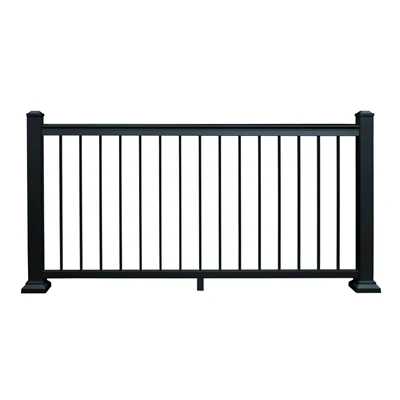
Selecting cable barriers is a professional decision that requires systematic control over everything from material selection, corrosion protection processes, specifications, installation quality, to contract acceptance.
1. Select materials precisely according to the usage environment to ensure durability.
The core of cable guardrails lies in the zinc alloy material, whose rust prevention principle is sacrificial anode protection: even if the surface is damaged, it protects the internal steel. When purchasing, first confirm whether the base material is Q235 carbon steel and whether the wall thickness meets the standards. For residential balconies or ordinary residential areas, a simple style with a height of 1.2 to 1.5 meters and a vertical bar spacing of ≤12 cm is recommended. For high-risk areas such as industrial parks, guardrails with a height of 2 to 2.5 meters and anti-climb structures should be selected. For highly corrosive environments such as the seaside or industrial areas, products with higher zinc content and stronger corrosion resistance should be selected to avoid rusting of ordinary guardrails in a short period.
2. Strictly control the double anti-corrosion process and prevent surface fraud.
The anti-corrosion process is the core factor determining the lifespan of zinc-steel guardrails. High-quality products must employ a dual protection system of "hot-dip galvanizing + electrostatic powder coating." The thickness of the hot-dip galvanized layer should not be less than 60 micrometers (85 micrometers or more is recommended under normal conditions), and the thickness of the electrostatic powder coating layer should not be less than 76 micrometers. The anti-corrosion lifespan can reach 15 to 25 years. It is particularly important to note that the zinc layer on the surface of "electro-galvanized" products on the market is extremely thin, with poor adhesion, and will rust and peel off within one or two years. Upon receiving the goods, the zinc layer thickness can be measured with calipers, and the manufacturer's third-party salt spray test report should be reviewed.
3. Verify key specifications and dimensions item by item to ensure safety.
The dimensional parameters of cable guardrails directly affect their safety performance. The wall thickness of the posts should not be less than 1.0 mm, the beam thickness is recommended to be no less than 1.2 mm, and the spacing between vertical bars should be strictly controlled within 11 to 12 cm to prevent children's heads from getting stuck or climbing over them. The post spacing should generally not exceed 1.2 meters to ensure overall structural stability in the event of an impact. Regarding height, residential balcony railings should not be less than 1.05 meters (no less than 1.1 meters for buildings over 7 stories), and industrial park fences are recommended to be at least 2 meters high. When purchasing, be sure to verify each item with calipers and a measuring tape; do not rely on verbal promises. Also, pay attention to welding quality-welds should be full and uniform, without any incomplete or missing welds.
4. Strictly control installation accuracy and pay attention to concealed works.
The installation quality directly determines whether the cable guardrail can achieve its expected lifespan. The foundation of the posts is of paramount importance: when installing on hardened ground, the post embedment depth should not be less than 30 cm, and a solidified concrete of C25 or higher quality should be used. During installation, the verticality of each post must be calibrated with a level; the allowable deviation in verticality should be ≤3 mm/m. All connectors and expansion bolts must be made of 304 stainless steel to prevent corrosion and loosening that could lead to the overall collapse of the railing. When installed on hollow brick walls, the anchoring must be deepened to the structural layer; otherwise, it is highly susceptible to detachment. After installation, a section-by-section shaking test should be conducted to confirm the overall stability of the railing.