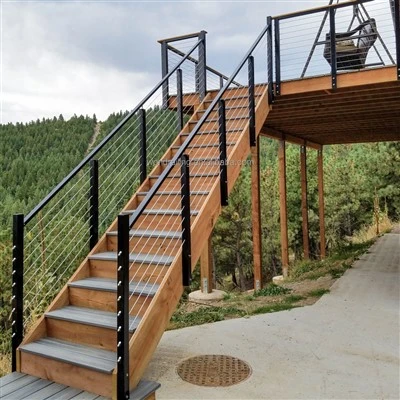
Cable guardrail (also known as cable guardrail, structural designation: Gc) is a major representative form of flexible guardrail. It refers to a flexible protective facility consisting of several cables under initial tension fixed to posts (or end posts). Its working principle is that when a vehicle collides, the tensile stress of the cables absorbs the collision energy. Based on the degree of deformation after the collision (i.e., stiffness), highway guardrails can be divided into three categories: flexible guardrails, semi-rigid guardrails, and rigid guardrails. Cable guardrails belong to the category of resilient guardrail structures with significant buffering capacity.
Cable guardrail is a representative form of flexible guardrail, referring to a flexible protective facility consisting of several cables under initial tension fixed to posts. The definition was approved and published by the National Committee for Terminology in Science and Technology in 1996 and included in the first edition of *Highway Traffic Science and Technology Terminology*. It absorbs collision energy through cable tensile stress and is divided into two categories according to the installation location: roadside (A/S level) and median strip (A level). The cable adopts a 3x7 galvanized right-hand twist structure, is made of Q235 steel, and is galvanized or powder coated.