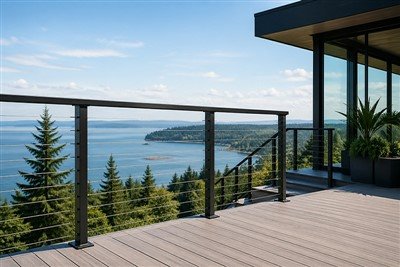
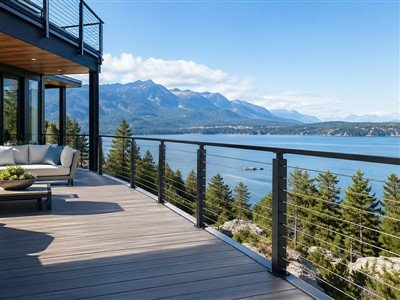
ZP Aluminum Co., Ltd. is one of the most reliable manufacturers and suppliers of horizontal aluminum cable railing in China. If you're going to buy bulk high quality horizontal aluminum cable railing made in China, welcome to get quotation from our factory. We also accept customized orders.
Horizontal Aluminum Cable Railing
- 6063-T6 Frame, Color-Matched
A powder-coated aluminum frame carrying taut, level 316 stainless cables - the low-profile guard that keeps the view open along the run. Frame decisions, cable engineering and how the two meet at the post, built to your layout.
A horizontal aluminum cable railing is a guard where a powder-coated aluminum frame - posts and a top and bottom rail - carries a run of taut, level stainless-steel cables stretched horizontally between the posts. The aluminum is the engineered part: it sets the height, color and corrosion class. The cables are the infill, chosen for their thin, nearly-invisible profile that keeps the view open along the run. We build every system to the project's actual layout - post spacing, cable count, coating class and anchor schedule - rather than shipping a fixed kit, because a horizontal cable run lives or dies on those numbers.

Which cable railing page fits your project?
- A horizontal run engineered for any frame (long-span, tension, sag)? See Horizontal Cable Railing.
- Comparing aluminum vs steel frames for cable, AAMA coating? See Metal Cable Railing.
- The cable itself - 1×19, diameter, 316 vs 304, break strength? See Steel Cable Railing.
- The powder-coat class and color decision for aluminum? See Powder Coated Aluminum Railing.
- A cable rail engineered for salt and spray? See Coastal Marine Grade Aluminum Railing.
- A full 316/304 stainless cable system for decks? See Stainless Steel Cable Railing Systems for Decks.
- Aluminum frame, horizontal cables, color-matched - you are in the right place.
What a Horizontal Aluminum Cable Railing Is
Strip it to parts and the system is two things working together:
- The aluminum frame - line posts, a top rail and a bottom rail, all extruded 6063-T6 and powder-coated. The frame is what the building inspector measures, what you anchor to the deck, and what you finish to match the rest of the job.
- The horizontal cables - a single plane of level stainless cables running parallel to the deck, spaced so a 4 in (100 mm) sphere cannot pass. They are the lowest-profile infill you can specify; from a few feet away the run reads as open air with a faint silver line.
The combination is the most common cable railing spec in residential and light-commercial work: an aluminum frame the contractor already knows how to set, with cables that disappear. This page is for the buyer who starts from "I want an aluminum railing, and I want horizontal cable" - frame decisions, cable engineering and how the two meet at the post.
Why Specify an Aluminum Frame for Horizontal Cable
Horizontal cables pull hard on the posts at every end and corner. The frame has to take that tension without deflecting, and it has to do it in the weather for decades. Aluminum earns the spot over steel and over a full-stainless build for four reasons:
| Factor | Aluminum frame (6063-T6 + powder coat) | Steel frame | Full 316 stainless |
| Weight | Light-easier handling, fewer anchors | Heavy | Medium-heavy |
| Corrosion | No rust; coating chips are field-repairable | Rusts if coating breaks | Best, but costliest |
| Color | Match any RAL/BS to the rest of the job | Limited paint colors | Bare metal only |
| Cost | Moderate | Low-moderate | 25-60% premium |
The practical story: an aluminum frame lets the cable rail disappear into an all-aluminum specification - gates, fascia and the cable posts finish the same color. At the coast or pool we run the marine build (thicker walls, 316 hardware, salt-spray tested) covered on our Coastal Marine Grade page, so the aluminum stays the value choice even in harsh sites. Against a full 316 stainless system, aluminum-framed cable delivers 90% of the look at a fraction of the cost, which is why it dominates decks and balconies that are not themselves stainless.


Engineering the Horizontal Run
This is where horizontal cable is its own discipline, and where a made-to-spec build beats a box kit. The cables are thin and long, so three numbers decide whether the run stays taut and code-clean:
- Post spacing. Keep line posts at 4–6 ft (1.2–1.8 m) on center. Beyond ~6 ft the cable needs a larger diameter or an intermediate post, because tension load grows with span.
- Cable diameter. 1/8 in (3.2 mm), 5/32 in (4 mm) or 3/16 in (4.8 mm) 1×19 stainless. Smaller diameters look finer but need closer posts; 3/16 in carries the longest spans.
- Cable count by height. Driven by the 4 in sphere rule, not a style choice. A 36 in (914 mm) guard takes about 10–11 cables; a 42 in (1067 mm) IBC/commercial guard takes about 12–13. We compute the count from your exact height and the gap under the bottom cable.
- Tension and sag. Each cable is tensioned to roughly 200–300 lb (0.9–1.3 kN) with turnbuckles at one end, then locked. The target is zero visible sag under its own weight and under the guard load - a slack cable fails the 4 in rule and looks cheap. On long runs we field-check tension after the frame settles, because a frame that deflects L/60 at the post lets the whole plane go slack.
- The top rail matters more here. Cables are not graspable, so on stairs and anywhere a handrail is required we add an aluminum top rail - which also stiffens the top of the frame and gives the cables a clean cap. On level deck runs the top rail is optional but recommended for both code and rigidity.
| Height | Typical cable count | Min post spacing | Recommended cable |
| 36 in (914mm) residential | 10-11 | 4-6 ft | 1/8–5/32 in |
| 42 in (1067 mm) IBC / commercial | 12-13 | 4-5 ft | 5/32–3/16 in |
| 48 in (1200 mm) pool barrier | 14-15 | 4 ft | 3/16 in |
| Queen | 153*203 | 37*37*163 | 108PCS |
| King | 183*203 | 37*37*193 | 108PCS |
The Aluminum Frame Build
The frame is extruded 6063-T6 - the same alloy family used across our aluminum rail lines - and built as a post-and-rail system:
- Posts - 2×2 in (50×50 mm) hollow section, 0.125 in (3.2 mm) wall, through-bolted or face-mounted to wood, concrete or steel.
- Top and bottom rails - capture the cable plane top and bottom; the top rail doubles as the graspable handrail where needed.
- Fasteners and hardware - 316 stainless at any coastal or pool site; the same grade we detail on the marine page.
- Finish - AAMA 2605 (PVDF fluoropolymer) for coastal, high-UV and pool exposure; AAMA 2604 polyester for sheltered inland runs. Black, white, bronze and beige standard, with custom RAL/BS matched for project volumes.
Because we run our own extrusion and powder-coat line, the cable frame, any gates and the rest of an aluminum job can ship in one matched finish - the kind of detail a box kit cannot promise.
Cable Specification
- Construction. 1×19 stainless steel - 19 wires in a single laid strand, stiff and non-flexing, the only construction suitable for a tensioned guard cable.
- Grade. 316 as standard for exterior work (the molybdenum content resists chloride pitting at the coast and pool); 304 only for confirmed dry, inland sites.
- Break strength. ~1,700 lb (0.75 t) at 1/8 in, ~4,200 lb (1.9 t) at 5/32 in, ~8,200 lb (3.7 t) at 3/16 in - every value far above the working tension, so the cable is never the weak link; the anchor and the post are.
- End fittings. Swaged studs or fork ends into adjustable turnbuckles; we pre-cut and pre-swage to length so field work is tension-and-lock, not measure-and-cut.
Code and Safety
A horizontal cable rail is judged like any guard, with the opening test applied to the cable plane:
- 4 in (100 mm) sphere rule - spacing and the gap under the bottom cable keep a child's head from passing; the count table above is derived from this.
- Height - 36 in (914 mm) residential per IRC R312; 42 in (1067 mm) IBC / commercial; 48 in (1200 mm) pool barriers.
- Loads - 200 lb (0.89 kN) concentrated and 50 lb/ft (0.73 kN/m) uniform horizontal under IBC 1015 / IRC R312; higher for public decks under BS 6180.
- Deflection - posts held within L/60 so the cable plane stays taut and the guard does not permanently deform.
- Climb consideration - horizontal cables can read as a ladder; we advise where a vertical or mixed infill is the safer code call (e.g. some childcare and school jurisdictions) rather than forcing cable everywhere.
Where a Horizontal Aluminum Cable Rail Goes
- Decks and balconies - the default application; the thin cable plane keeps the outlook open.
- Porches and perimeter rails - color-matched to the fascia and trim.
- Rooftop terraces - marine build within ~10 mi (16 km) of the sea or at a chlorinated pool.
- Light-commercial and hospitality - long level runs where a near-invisible guard is the design intent.
- Stairs - horizontal cable on the incline is possible with a top handrail; we template the pitch so the cable spacing stays compliant up the slope.
Made to Your Drawing, Not a Catalog
Every horizontal aluminum cable run we ship is engineered to the site:
- CAD and shop drawings - post schedule, cable count, anchor type and coating class per elevation.
- Load and deflection notes - post spacing and wall sized to your height and local load, with PE-stamp support where the jurisdiction requires sealed calculations (IBC, IRC, BS 6180, AS/NZS 1170).
- Sample panel - a coated post section with tensioned cables is available so you can verify finish, cable spacing and rigidity before a full order.
- Transparent terms - MOQ, lead time and FOB price range stated up front; references on comparable deck and balcony jobs on request.
We are a railing manufacturer with in-house aluminum extrusion, powder coating and cable swaging - not a reseller - so the frame, the finish and the cable length are all controlled in one plant and one quality loop.
Typical Specification
| Parameter | Standard |
| Frame | 6063-T6 aluminum, hollow extrusion |
| Posts | 2×2 in, 0.125 in wall, 4–6 ft spacing |
| Rails | Top + bottom, aluminum, graspable top option |
| Coating | AAMA 2604 or 2605 (PVDF) |
| Cable | 1×19 stainless, 316 standard / 304 inland |
| Diameter | 1/8 / 5/32 / 3/16 in |
| Cable count | 10–11 @36 in · 12–13 @42 in · 14–15 @48 in |
| Tension | 200–300 lb, turnbuckle-locked |
| Height | 36″ residential · 42″ IBC · 48″ pool |
| Opening | ≤ 4 in (100 mm) sphere |
| Load | 200 lb point · 50 lb/ft (IBC 1015 / IRC R312) |
| Deflection | ≤ L/60 at post |
| Hardware | 316 stainless (coastal/pool) |
| Color | Black / white / bronze / custom RAL |
| Engineering | CAD · load-deflection · PE stamp on request |
Request a Quote or Sample
Send the run length, height (36 / 42 / 48 in), post spacing or deck material, cable preference (1/8 / 5/32 / 3/16 in), color (standard or RAL/BS) and any stairs or corners. We return a quote with the engineered cable count, frame coating class, anchor schedule and lead time - usually within two business days. A coated post section with tensioned cable is available so you can confirm the finish and rigidity before committing.
Frequently Asked Questions
Q: Is a horizontal aluminum cable railing really aluminum?
A: Yes - the posts, top and bottom rails are extruded 6063-T6 aluminum, powder-coated and finished like any other aluminum rail. The "cable" part is stainless infill; the aluminum is the structural frame you anchor and finish.
Q: Why not a steel or full-stainless frame?
A: Aluminum is lighter, color-matched to the rest of the job, and field-repairable if the coating chips. Full 316 stainless costs 25–60% more for a look most viewers cannot tell apart on a deck. Steel is cheaper but heavier and rusts if its coating breaks. Aluminum is the value middle.
Q: How many cables do I need?
A: It follows the 4 in sphere rule from your guard height: about 10–11 cables at 36 in, 12–13 at 42 in, 14–15 at 48 in. We compute the exact count including the gap under the bottom cable for your project.
Q: Will the cables sag over time?
A: Not if the run is engineered. Each cable is tensioned to 200–300 lb and locked with turnbuckles, and the posts are sized to L/60 deflection so the frame does not let the plane go slack. We re-check tension on long runs after the frame settles.
Q: Does a horizontal cable rail need a top rail?
A: On stairs and anywhere a graspable handrail is required, yes - and it also stiffens the top of the frame. On level deck runs the top rail is optional but we usually recommend it for rigidity and code headroom.
Q: Can horizontal cable be used on stairs?
A: Yes, with the incline templated so cable spacing stays compliant up the slope, plus a top handrail. We template the pitch from your rise and run rather than guessing.
Q: Do you supply engineering for permits?
A: Yes - CAD / shop drawings, an anchor and post schedule, and load-and-deflection notes, with PE-stamp support where your jurisdiction requires sealed calculations, to IBC, IRC, BS 6180 or AS/NZS 1170.
Hot Tags: horizontal aluminum cable railing, China horizontal aluminum cable railing manufacturers, suppliers, factory, Aluminum Cable Railing System, Black Aluminum Cable Railing, cable railing, commercial cable railing systems, Modern Aluminum Cable Railing, outdoor deck cable railing systems