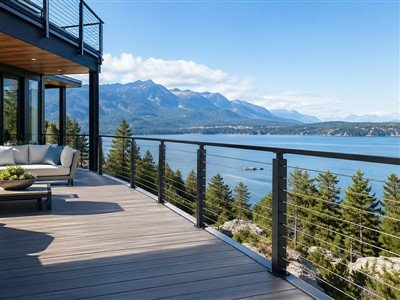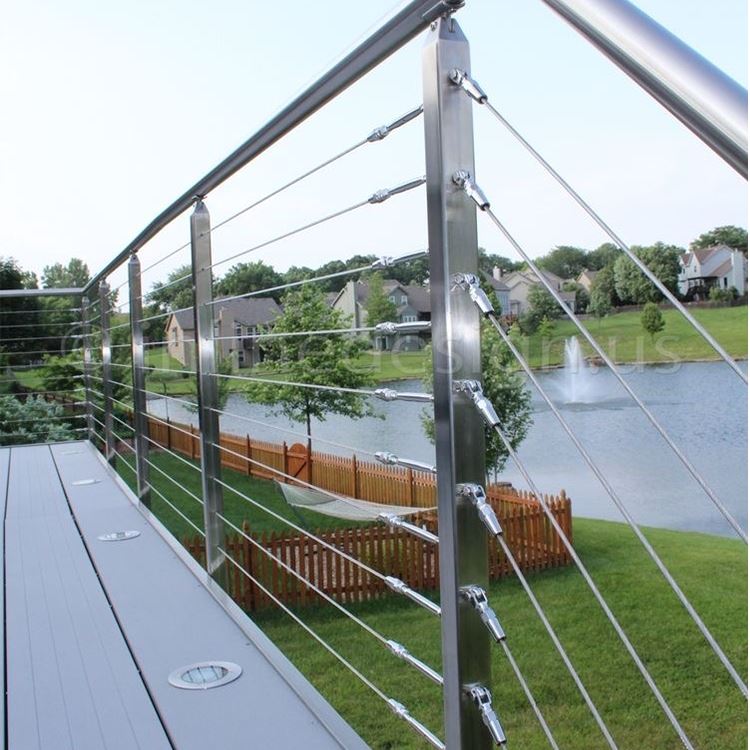
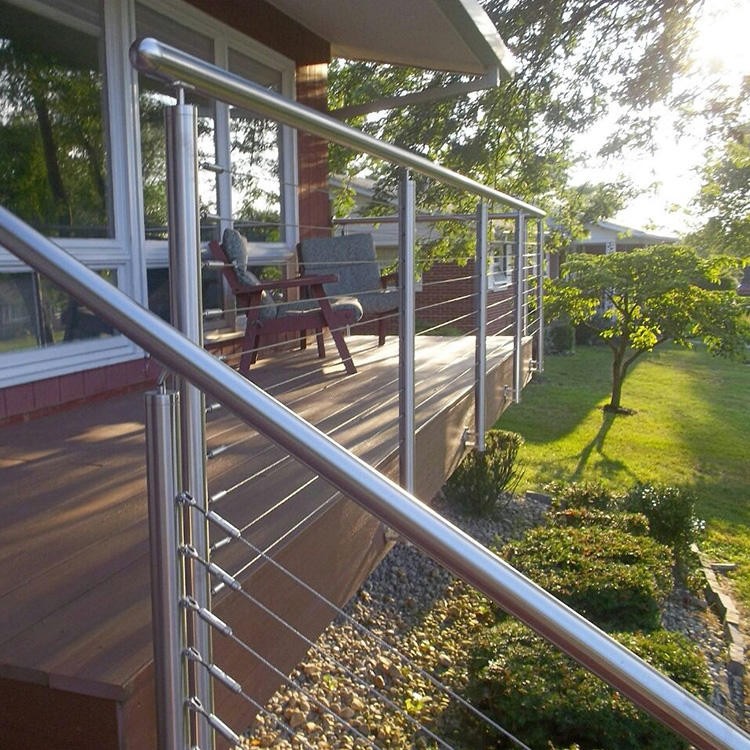
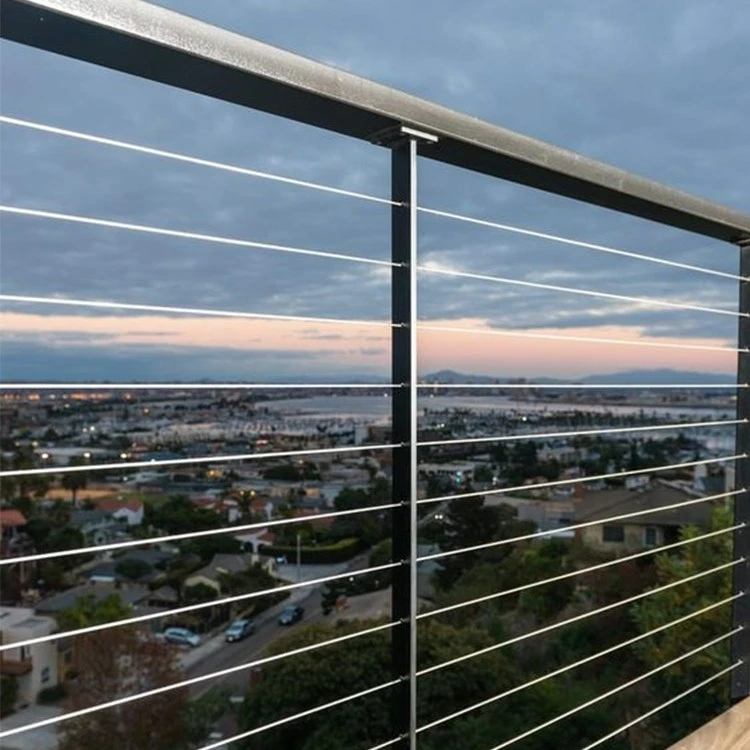
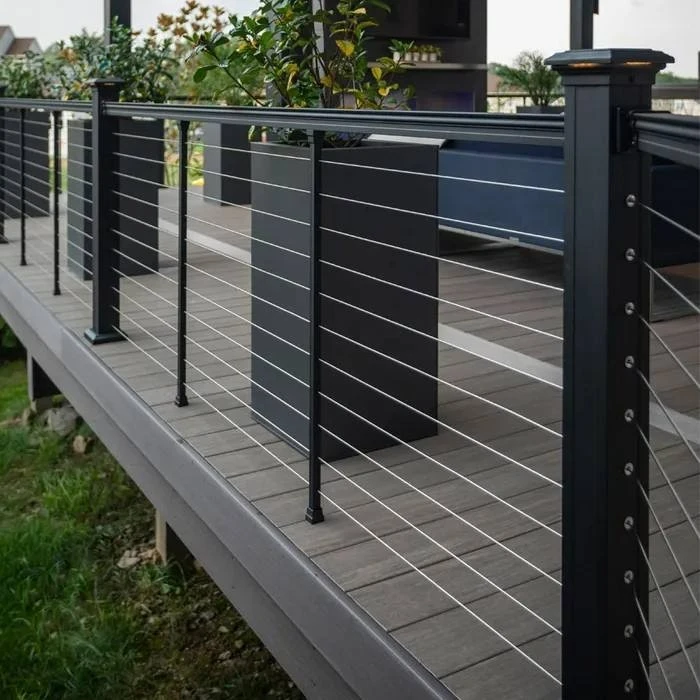
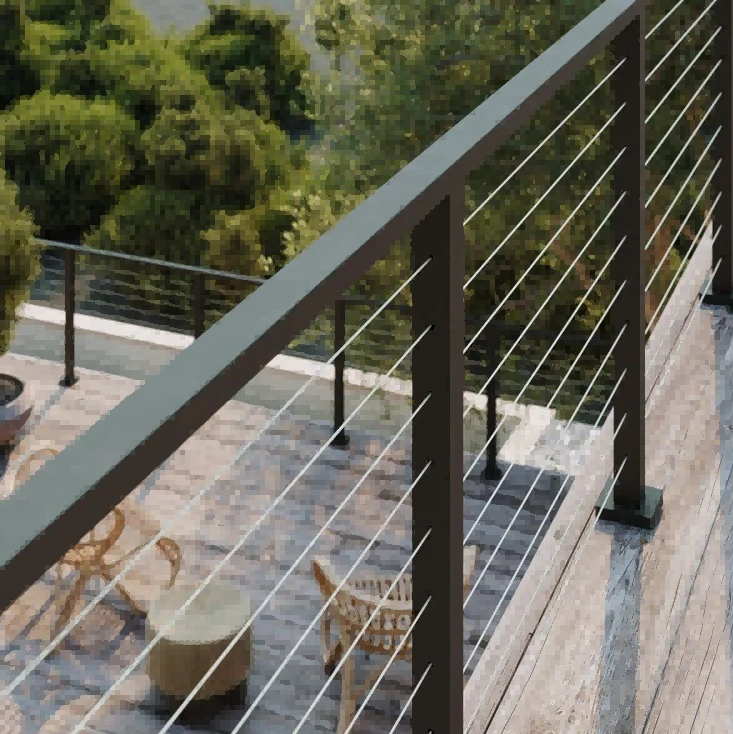
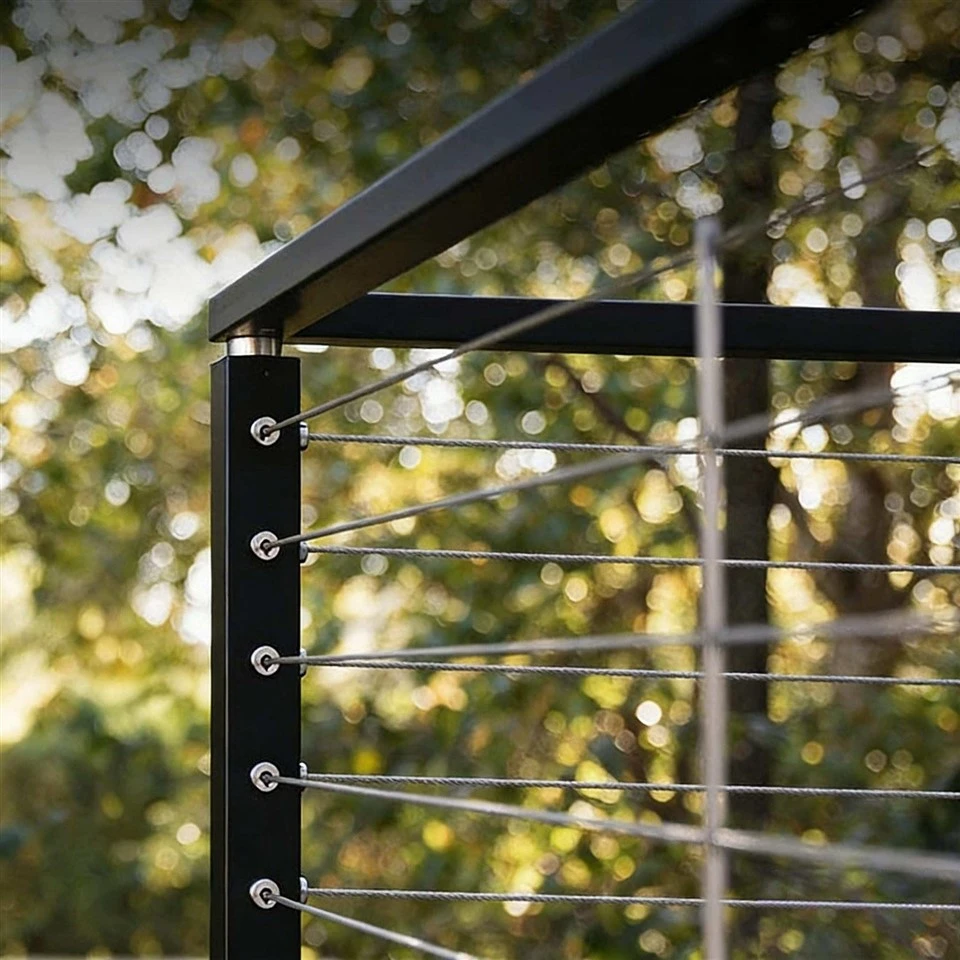
ZP Aluminum Co., Ltd. is one of the most reliable manufacturers and suppliers of wire railing systems in China. If you're going to buy bulk high quality wire railing systems made in China, welcome to get quotation from our factory. We also accept customized orders.
Wire Railing Systems: Tensioned Wire & Woven Wire Mesh, Built as One Coordinated Kit
A wire railing system is a guard built from slender stainless wire set between structural posts - either as taut tensioned lines, or as rigid woven wire mesh panels framed in aluminum or steel. You get the open, light-filled look, but with a choice most suppliers never offer: lines for the thinnest sightline, or mesh for zero tensioning and built-in child/pet safety. We engineer the whole system to your drawing and ship it as one kit.

Pick the right wire railing page
"Wire railing" usually means cable railing. This page covers the system and the mesh option. For the deep dives, jump to:
Steel Cable Railing - cable construction, diameter, 316 vs 304, tensioning hardware (the material reference).
Horizontal Cable Railing - long-run engineering, end-post moment, center-out tensioning.
Vertical Cable Railing - climb-safe orientation for schools, HOA and child-focused specs.
Metal Cable Railing - the full aluminum/steel frame system vs a wood frame.
Cable Railing on a Deck - surface vs fascia mount, rim-joist blocking.
Modern Cable Railing - profiles, matte-black trends, mixed materials.
What a wire railing system is - and the two infill families
"Wire railing" is the trade shorthand for a guard where the infill is slender steel wire rather than glass, bars or pickets. In practice the family splits into two very different products, and the right choice depends on whether you can live with tensioning maintenance and how much fall-protection certainty you need:
- Tensioned wire lines - individual stainless wires pulled taut between posts, like a harp. The look is the thinnest possible; the trade-off is that the wires must stay under tension (typically 200+ lb per line) or they sag and fail the 4″ sphere rule.
- Woven wire mesh panels - a rigid sheet of interwoven stainless wire, crimped flat and framed. There is no tension to maintain and no sag; the opening size alone controls the sphere rule. This is the option schools, transit platforms and pet owners reach for.
Both hang in the same structural frame, which is why we treat them as one system rather than two products. The sections below cover each infill, then the shared frame, hardware and the engineering we put behind every order.
Tensioned wire infill (the cable option)
For runs where the sightline matters most, tensioned wire is unbeatable. Marine-grade 316 stainless is pulled between posts with turnbuckles or swageless fittings until it reads as a single clean line. The engineering reality - and the part cheap kits get wrong - is load: under a 200 lb point load the wire deflects, so posts sit close (roughly 4 ft) and lines are spaced about 3″ center-to-center to pre-compensate. Full diameter, break-strength and fitting detail lives on our Steel Cable Railing page; the long-run and orientation math is on the horizontal and vertical pages.
Woven wire mesh infill - rigid, no tensioning, sphere-safe by aperture
This is where a wire system diverges from ordinary cable. A woven mesh panel is a rigid architectural screen: round wires and flat wire strips interwoven, crimped flat, then framed in aluminum or steel. Because the panel is rigid, it needs no tensioning, sags nothing, and meets the 4″ / 100 mm sphere rule purely by its clear opening size - not by how tight you wound a turnbuckle.
Typical woven mesh specifications (representative patterns)
| Property | Tight security mesh | Balcony mesh | Open decorative mesh |
| Wire rod diameter | 2mm | 2mm | 3.2mm |
| Flat strip | 3.8 × 1.5 mm | 4.8 × 1.5 mm | - (round wire) |
| Clear opening | 5 × 6 mm | 8 × 8 mm | 30 × 30 mm |
| Open area | ~48% | ~51% | ~80% |
| Panel weight | ~8 kg/m² | ~6.7 kg/m² | ~3.4 kg/m² |
| Material | SS304 / 316 | SS304 / 316 | SS304 / 316 |
| Finishes | mill, antique brass/copper, PVD, PVDF, powder coat | mill, antique plating, PVD, powder coat | mill, PVD, powder coat, painted |
Openings are chosen per project: keep the clear opening under 100 mm (4″) for the sphere rule; tighter apertures (5–8 mm) add security and anti-climb at the cost of some see-through.

Where mesh beats tensioned cable
- No tensioning, ever. A framed rigid panel cannot slacken, so there is no annual re-tightening and no "loose cable" inspection fail.
- Child and pet certainty. With a sub-100 mm aperture there is no climbable rung and no gap a small pet or ball passes through - a frequent HOA and school requirement.
- Anti-climb and impact. Rigid mesh resists scaling and takes dynamic impact better than slender lines, which is why transit platforms, stadiums and schools specify it.
- Vandal and weather resistance. Welded/crimped panels shrug off tampering; powder-coated aluminum frames survive coastal spray for decades.
The system, not just the parts
A wire railing "system" is the coordinated set we ship so the site crew assembles rather than engineers. Every order is built around your drawing:
Posts & mounting
Structural posts in 6063-T6 aluminum (powder-coated to AAMA 2604 / 2605) or 316 stainless for harsh coastal and transit use. Mounting is surface (base plate to deck or slab) or side/fascia (clamped to the edge) - your call per substrate. Posts are pre-drilled for the infill you chose and pre-cut to height.
Tensioning hardware (wire lines)
For tensioned lines we supply swage or swageless terminals, turnbuckles and eyebolts in 316 stainless, sized so a single person can bring each line to spec tension on site without special crimping tools.
Mesh framing
For mesh we CNC-cut panels to your exact dimensions, then lock them into the aluminum/steel frame with welded or mechanical retainers engineered to transfer load into the posts. Riveted or bolted, the connection is detailed on the shop drawing we send for sign-off.
Wire railing system - core specification
| Item | Our standard |
| Guard height | 36″ residential (IRC) · 42″ commercial / IBC · 42″ mandated in some US states & NYC residential |
| Opening / sphere rule | ≤ 4″ (100 mm) - lines at ~3″ centers; mesh by aperture (5–30 mm per spec) |
| Load | 200 lb concentrated / 50 lb per lineal foot (IBC 2407); mesh resists impact without tension |
| Wire / cable | 3 mm wire rope or 1/8–3/16″ cable, 316 marine grade; 304 inland |
| Mesh material | SS304 / 316, rigid woven, framed |
| Frame | 6063-T6 aluminum, AAMA 2604 (2605 coastal) powder coat; or 316 SS |
| Standards referenced | IRC R312 · IBC 2407 · BS 6180:2011 (UK, 100 mm sphere) · AS/NZS 1170 (AU) |


Code & safety, by infill type
The safety target is the same for both infills - a guard that stops a fall and blocks a 4″ / 100 mm sphere - but how each gets there differs:
- Tensioned lines meet the sphere rule only while tensioned. That is why codes tie line spacing to post spacing and why we calculate deflection under the 200 lb load rather than guessing.
- Woven mesh meets the sphere rule by its fixed aperture. Pick an opening under 100 mm and the panel passes regardless of load - simpler to specify, simpler to inspect.
Height is 36″ for most US residential guards (triggered above a 30″ fall) and 42″ for IBC commercial; the UK uses a 100 mm sphere and BS 6180 load classes; Australia references AS/NZS 1170. We produce the calculation pack for the jurisdiction your project sits in.
Engineered and built to your drawing
Wire railing looks simple and is not. Load paths, post spacing, tension pre-load and mesh retention all have to be right before a panel leaves the factory - which is exactly the work we do so your installer does not have to. For every order we:
- Review your site drawing or measured layout and propose post positions, mounting type and infill spacing;
- Run the load and deflection check for the chosen infill and jurisdiction, and document it;
- Issue CAD / shop drawings for sign-off, including any PE stamp your authority having jurisdiction requires (where we are licensed to provide it);
- Cut, drill and finish the parts as one coordinated kit, labelled for assembly.
That is the difference between a catalogue reseller and a manufacturing partner: you send a drawing, you receive a system that is already engineered.
Built by a railing manufacturer, not a reseller
Most "wire railing" listings online are trading desks dropshipping the same import. We extrude, fabricate and finish in our own plant, so the engineer who answers your question is the one who set the production line. What that changes for your project:
- The system ships engineered, not guessed. Every order is reviewed against the code that governs your site - IRC R312, IBC 2407, BS 6180:2011 or AS/NZS 1170 - with the load and deflection work documented and the shop drawing issued for sign-off before a single post is cut.
- Material is chosen for the site, not the shelf. 316 where salt is in the air, 304 inland; AAMA 2605 on coastal frames; mesh aperture sized to the sphere rule your jurisdiction enforces. We flag the environment before we quote, not after.
- You can verify us. Documented warranty on frame and finish, a real factory address, direct engineering contact, and references or project photos on request - no anonymous "trusted by thousands". Sample panels ship before any bulk commitment.
- The spec sheet travels with the order. The calculation pack, bill of materials and finish schedule are written so your architect or inspector can read them without a call-back.
That is the difference between a catalogue and a manufacturing partner: you send a drawing, you get a system that is already right.
Where wire railing systems go
Residential - balconies, decks, stair runs and rooftop terraces where the open look sells the view.
Commercial & public - malls, offices, transit platforms and schools, where woven mesh gives anti-climb and impact resistance at scale.
Coastal & pool - 316 stainless + 2605 powder coat survive salt spray; mesh keeps the 4″ rule with zero sag.
Pet & child spaces - tight-aperture mesh removes the climb-and-squeeze risk that worries HOA and family buyers.
Wire vs cable - what buyers actually ask
"Wire" and "cable" railing are the same product family; "wire" is the older UK/AU term, "cable" the US one. The real decision is infill type: tensioned lines for the thinnest sightline, or rigid woven mesh for no maintenance and built-in safety. Many of our projects mix them - mesh on the stair core where climb-safety is audited, lines on the balcony where the view is the selling point - within one coordinated frame system.
Frequently asked questions
Q: Is "wire railing" the same as "cable railing"?
A: Yes for the tensioned-line version - "wire" is the common UK/AU term, "cable" the US one, both meaning slender stainless wires pulled taut between posts. A wire railing system also includes the rigid woven mesh option, which ordinary "cable railing" pages rarely cover. Use our fork box above to reach the cable-material and orientation deep dives.
Q: Do woven wire mesh panels need tensioning like cable?
A: No. Mesh is a rigid, crimped-and-framed panel - it is held in the frame by welds or mechanical retainers, not by tension. There is no turnbuckle to wind, no slack to develop, and nothing to re-tighten seasonally. That is the main reason schools, transit decks and low-maintenance specifiers choose mesh over lines.
Q: What mesh aperture keeps a 4″ / 100 mm sphere out?
A: The clear opening must stay under 100 mm (4″). Our mesh patterns run from ~5 mm (high-security, anti-climb) through 8 mm (balcony) up to 30 mm (decorative, still sub-sphere at the tight end of the range). We size the aperture to your jurisdiction - IRC/IBC 4″, UK 100 mm, AU per AS/NZS - and confirm it on the shop drawing.
Q: Is wire mesh safer than cable for kids and pets?
A: For many specs, yes. A sub-100 mm rigid aperture gives no climbable rung and no gap a small pet or ball passes through, and it cannot slacken. Tensioned lines meet the same rule only while correctly tensioned and spaced. Where a code official or HOA audits climb-safety, mesh removes the argument.
Q: Can I mix wire lines and mesh in one system?
A: Yes, and we do it routinely. A single aluminum or stainless frame system can carry tensioned lines on the balcony run and rigid mesh on the stair core or pet area, with the change detailed on one coordinated drawing. Tell us the zones and we engineer both infills into the same post schedule.
Q: How much does a wire railing system cost per foot?
A: Market ranges run about $75–$150 / ft for a DIY materials kit, $150–$225 / ft for a complete mid-range system (posts, infill, hardware, top rail), and $225+ / ft for premium stainless or fully custom. Installed pricing is higher and varies by region, stairs and corners. {{BRAND}} quotes factory-direct; request a number against your drawing rather than a generic rate.
Q: Is a wire railing system DIY-friendly or do I need a pro?
A: Straight, well-framed level runs suit a quality kit and a competent installer. Stairs, multiple corners, elevated balconies and any job needing a PE stamp or inspection usually pays to use a pro - they absorb code rework risk and bring tensioning/alignment gear. We supply engineered drawings either way, so the difference is site labour, not design.
Q: Will the wire rust near the coast?
A: Not if specified right. We use 316 marine-grade stainless for wire/cable and mesh in coastal and pool environments, paired with AAMA 2605 powder-coated aluminum frames. Inland, 304 stainless is adequate. The failure mode is almost always a buyer saving on grade - we flag the environment before we quote, not after.
Hot Tags: wire railing systems, China wire railing systems manufacturers, suppliers, factory, Black Aluminum Cable Railing, cable railing, modern outdoor cable railing, outdoor cable railing systems, outdoor deck cable railing systems, outdoor stainless steel cable railing