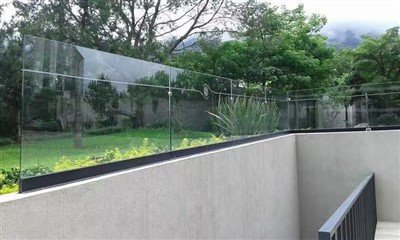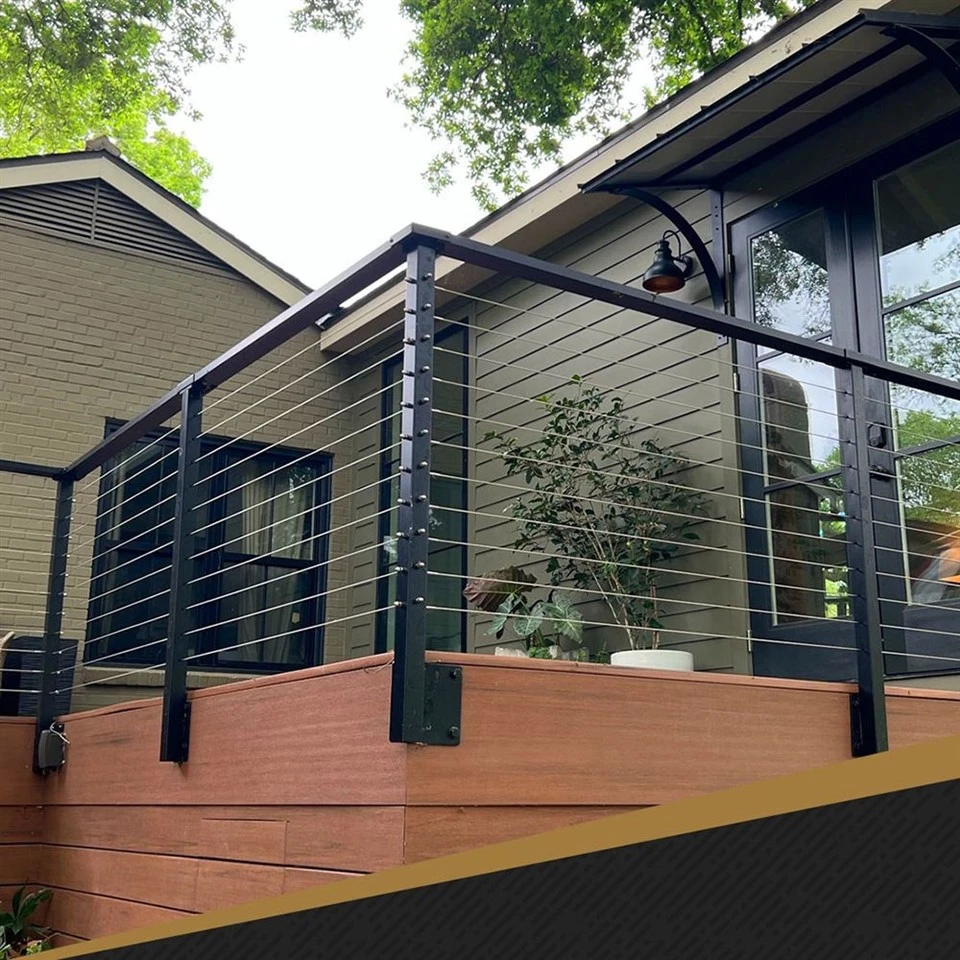
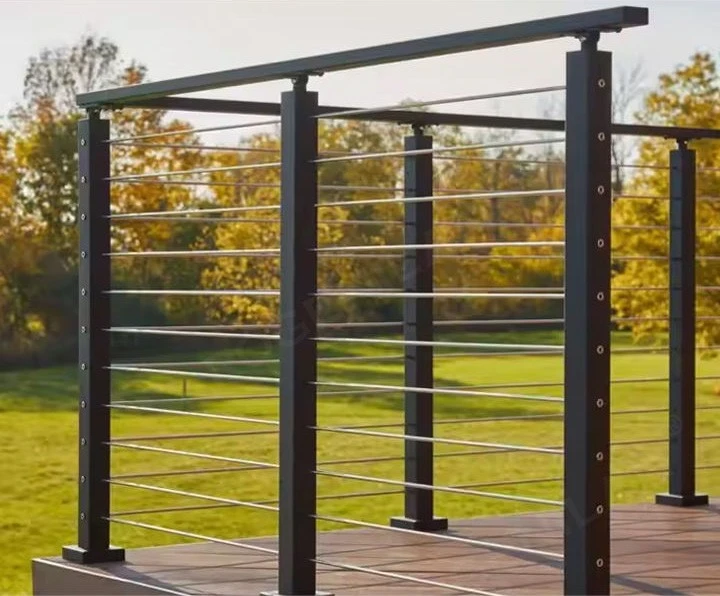
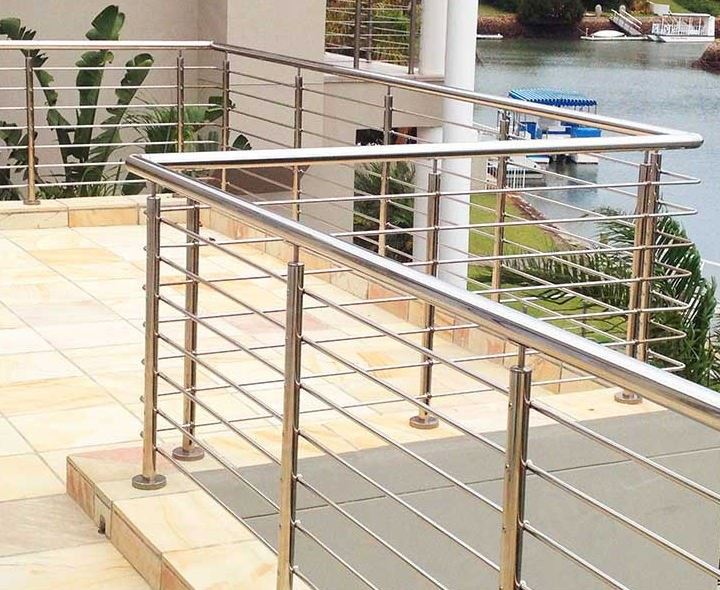
ZP Aluminum Co., Ltd. is one of the most reliable manufacturers and suppliers of horizontal cable railing in China. If you're going to buy bulk high quality horizontal cable railing made in China, welcome to get quotation from our factory. We also accept customized orders.
Horizontal Cable Railing - Long Runs, Clear Views, Engineered to Stay Taut
When a project is about the view, horizontal cable is the guard architects reach for first. Thin stainless lines run parallel to the horizon, the eye reads "open," and a 40-foot deck disappears into the water behind it. The part most suppliers skip is the engineering that keeps those lines straight under load - and that is exactly where a manufacturer-built system earns its money. Cable diameters, grades and break strengths are detailed on our Steel Cable Railing page; this page is about the run - how a horizontal system is engineered, spaced and tensioned to stay taut. The climb-safe vertical orientation is on our Vertical Cable Railing page.

Why horizontal cable became the modern default
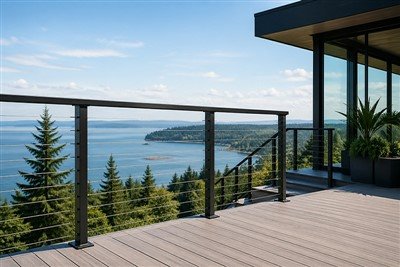
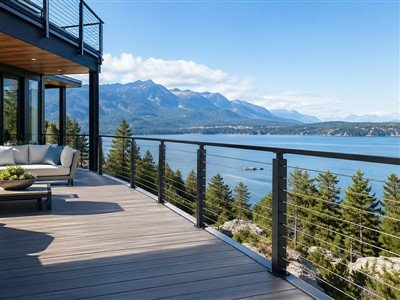
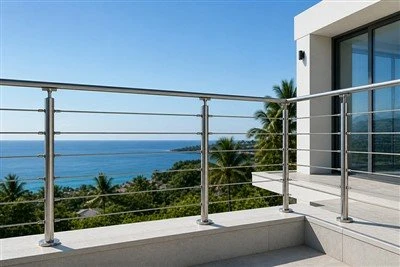
Horizontal cable did not win on cost - it won on sightlines. A picket guard interrupts the view every few inches; glass adds a reflective plane and weight. Cable, at 1/8″–3/16″ diameter, is almost invisible past about ten feet, so the barrier reads as "nothing there" and the landscape does the talking. That is why it shows up on clifftop residences, restaurant terraces and any elevation where the whole point of the deck is the horizon.
It also suits long, straight runs better than any other infill. A single cable can span an entire 12- or 18-foot face with just two fittings, so a big elevation becomes fewer parts, fewer connections and a cleaner line. The trade-off is that horizontal cable is a dynamic system: the infill is always under tension and always pulling inward on the frame. Design the frame for that and it is bulletproof; ignore it and the first summer the lines go soft.
The engineering that keeps a horizontal run safe
This is the section that separates a catalog kit from a system a structural engineer will sign off. A horizontal cable guard is not "posts plus wire" - it is one structural assembly where the cable, the top rail and the end posts share load. Treat them separately and the numbers do not close.
The top rail is a structural member, not a handhold
In a cable system the top rail does double duty. It is the graspable guard top, yes, but it is also the compression member that ties a run together. When every cable pulls inward, a continuous, well-anchored top rail resists that pull and stops the end posts from leaning. Systems that bolt a flimsy cap rail on at the end are the ones that drift out of tension within a season. We size the top rail as part of the load path, not as trim.
End posts are levers - the moment connection matters most
Cables pull inward, so the terminal (end) posts behave like levers pivoting at their base. A typical 36″ residential run of ten cables, each tensioned to roughly 200–300 lb, puts a cumulative 2,000–3,000 lb of inward force on the end posts. That force has to be resisted at the base moment connection and by the top rail acting in compression. Undersized or soft-mounted end posts bow, the cables lose tension, and an inspector's 4″ sphere suddenly drops through. Our fabrication specs the end-post base connection and stiffener geometry for the actual run length - not a generic "4×4 will do."
Load the frame is built to resist (IBC / IRC)
Top rail: 200 lb concentrated load at any point, any direction.
Top rail: 50 lb per linear foot uniform load.
Infill (each cable): 50 lb over a ~1 sq ft area without opening beyond the limit.
Guard height: 36″ residential · 42″ commercial / IBC (some states - CA, WA - require 42″ on residential decks too).
Guard trigger: any surface more than 30″ above grade (IRC).


Spacing the cables so deflection never beats the 4″ sphere
The "4-inch sphere rule" sounds like a layout problem. With cable it is a physics problem: a cable spaced exactly 4″ apart stretches past 5–6″ when pushed, so a child's sphere passes. The field fix everyone converges on is 3″ to 3.125″ center-to-center cable spacing - you pre-compensate so that even under a 50 lb outward push the gap never exceeds 4″. We lay out 8 cable runs for a 36″ guard and 10 runs for a 42″ guard to land in that window.
Post spacing, and when you need intermediate stabilizer posts
Industry practice holds post spacing at about 4 ft on center. Longer spans between full structural posts mean more cable deflection for the same tension, so above roughly 6 ft we add non-structural intermediate stabilizer posts to limit cable spread. Cable diameter shifts the math: 3/16″ cable typically holds 3–4 ft spans, 1/4″ pushes toward 4–5 ft. Tell us the span and we specify the post map, not the other way around.
| Cable Diameter | Typical max post span | Notes |
| 1/8″ (3.2 mm) | ≤ 3 ft | Standard residential; ~1,800 lb break |
| 3/16″ (4.8 mm) | 3–4 ft | Most common; bolder look, more margin |
| 1/4″ (6.4 mm) | 4–5 ft | Long runs / heavy-duty |
The tensioning sequence - and why it is not random
Tensioning from one end to the other bows the frame and leaves uneven lines. The correct sequence is center-out, alternating up and down, finishing with the top and bottom runs, targeting ~200–300 lb per cable. Over-tensioning is the common DIY error: past ~400 lb per cable you risk bending posts and distorting hardware, which makes the system less safe. After install, re-check tension in the first month as the cable settles, then on a 6- and 12-month cycle.
Horizontal vs vertical cable - choosing the orientation
Both are cable; the orientation changes safety, cost and look. We build both, so this is straight talk, not a sales push:
| Factor | Horizontal | Vertical |
| View interruption | Minimal - runs parallel to horizon | Slightly more - vertical lines cross the view |
| Climb risk (children / pool) | Can read as a ladder; not permitted as a pool enclosure | Reduced climb risk; only orientation allowed for pool barriers |
| Hardware count | 2 fittings per long run | Up to ~5× tensioners; one per cable |
| Cost | Generally lower | Higher (more fittings + heavier top/bottom rail) |
| Best fit | Water views, modern facades, long straight runs | Families with small children, wooded views, pool decks |
If your jurisdiction or HOA enforces a "no-climb" rule, or the guard faces a pool, specify vertical - see our vertical cable railing page. Otherwise, for a view deck,horizontal is the stronger choice.
Where horizontal cable earns its keep
Waterfront and view decks - the whole reason to build the deck; cable keeps the horizon clean.
Commercial view terraces and restaurants - long, uninterrupted runs read as premium and need less hardware.
Modern residential facades and balconies - horizontal lines reinforce contemporary architecture.
Long, straight elevations - one cable, two fittings, no mid-run breaks.
Cable, fittings and corrosion spec
This page is about the run, not the raw material - so the full diameter, break-strength and corrosion tables live on our Steel Cable Railing spec page. In short: we run 1×19 construction stainless as standard because its rigidity minimizes lateral deflection between posts (7×19 is more flexible and needs tighter post spacing). For outdoor and coastal work, T316 marine grade is the baseline; within roughly 10 miles of salt water, anything less invites tea-staining and pitting. Indoor or dry-climate runs can drop to 304. The point here is that the spec is chosen for the run, not pulled off a shelf.

Horizontal cable on stairs
Horizontal cable works on stairs, but the guard alone is not a handrail. Codes require a separate, graspable handrail (1¼–2″ round, 34–38″ above the nosing) on any stair with four or more risers. Cable on the stair angle also uses different fittings and a tighter layout at the triangle where the guard meets the tread - that triangle gets the 6″ sphere exception, not 4″. We cut stair runs to the actual rise/run and supply the independent handrail as part of the same drawing.
Built to your drawing - engineered and fabricated to spec
We are a railing manufacturer, not a reseller with a catalog. For a horizontal cable project that means:
Drawn to your span. Send the layout - elevations, post centers, height and finish - and we return CAD shop drawings with the post map, cable runs and tension values called out.
Engineered for the load. End-post moment connections, top-rail compression sizing and post spacing are calculated for your actual run length and local load requirement, not a generic rule of thumb.

Finish to match. Aluminum posts in any RAL powder-coat; stainless in brushed or matched coating; cable diameter per the span table above.
Stamp-ready on request. For commercial or high-rise work we support PE review and sealed drawings where the jurisdiction requires them.
Direct from the factory. One less markup layer, and the people who drew it are the people who built it.
Frequently asked questions
Q: How far apart can horizontal cable posts be?
A: About 4 ft on center is the industry standard for keeping deflection inside the 4″ sphere limit. For spans beyond ~6 ft we add intermediate stabilizer posts. The exact map depends on cable diameter (3/16″ holds 3–4 ft; 1/4″ pushes to 4–5 ft) and the run length - we specify it on the shop drawing.
Q: Why do inspectors want cable spacing at 3 inches instead of 4?
A: Because cable deflects. Spaced exactly 4″ apart, a cable stretches past 5–6″ when pushed, and a 4″ sphere drops through. Setting cables at 3–3.125″ center-to-center pre-compensates, so even under a 50 lb push the opening stays under 4″. It is the accepted field fix for the sphere rule.
Q: Is horizontal cable safe if I have small children?
A: The guard itself is safe and code-compliant when built to spec, but the horizontal lines can read as a ladder, so some jurisdictions, HOAs and all pool-enclosure codes restrict or ban horizontal cable. If climb risk is a concern, specify our vertical cable orientation, which removes the ladder effect.
Q: How much tension should each horizontal cable have?
A: Typically 200–300 lb per cable for a residential run, applied center-out and alternating. Stay under ~400 lb - over-tensioning can bend posts and distort fittings, which actually weakens the system. Re-check after the first month and on a 6/12-month cycle.
Q: Can horizontal cable be used on stairs?
A: Yes, with a separate graspable handrail (1¼–2″ round, 34–38″ above the nosing) - the cable guard is not a handrail. Stair runs use angle-specific fittings and a tighter layout at the tread triangle, which gets the 6″ sphere exception. We cut stair runs to your actual rise and run.
Q: Horizontal or vertical - which should I specify?
A: Pick horizontal for maximum view, modern look and lower hardware cost on a view or commercial deck. Pick vertical for families with small children, wooded settings, or anywhere a no-climb or pool rule applies. Both are cable; the orientation is a safety-and-aesthetics call, not a quality one.
Q: What cable size do I need for a long horizontal run?
A: 1/8″ is the residential standard; 3/16″ is most common and gives more margin; 1/4″ is for long spans (4–5 ft post centers) or heavy-duty commercial use. We choose the diameter from your span and post map rather than defaulting to one size.
Q: Can you build horizontal cable to my dimensions and finish?
A: Yes. Send the elevation, post centers, height (36″/42″) and finish, and we return CAD shop drawings with post spacing, cable runs and tension values, then fabricate to those drawings in your chosen powder-coat or stainless finish. Project lots and direct-container shipping are available.
Hot Tags: horizontal cable railing, China horizontal cable railing manufacturers, suppliers, factory, commercial cable railing systems, Modern Aluminum Cable Railing, modern outdoor cable railing, Outdoor Aluminum Cable Railing, outdoor stainless steel cable railing, Residential Aluminum Cable Railing