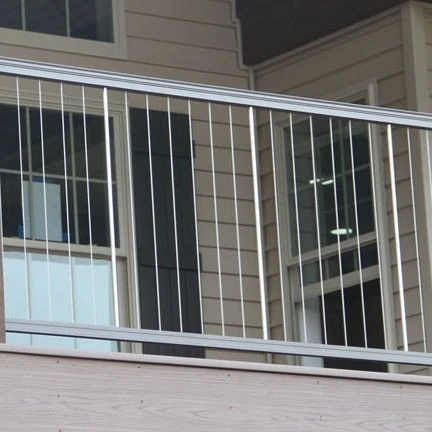
ZP Aluminum Co., Ltd. is one of the most reliable manufacturers and suppliers of vertical cable railing in China. If you're going to buy bulk high quality vertical cable railing made in China, welcome to get quotation from our factory. We also accept customized orders.
Vertical Cable Railing
- The Climb-Proof Infill for Family Decks & Commercial Guards
If the guard has to satisfy a parent, a restaurant inspector, or a homeowner association that frowns on horizontal lines, vertical cable is the orientation that removes the objection. The cables run top-to-bottom between a rigid top and bottom rail instead of side to side, so there is no ladder for a child to climb - and no horizontal member for a local amendment to ban. You keep the thin, near-invisible stainless look; you just get it without the climbability debate.


Why Orientation Decides the Safety Conversation
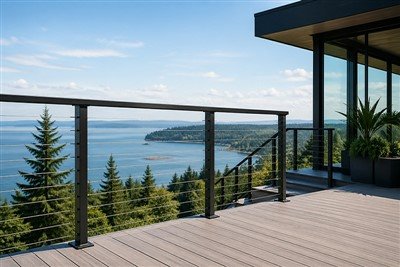
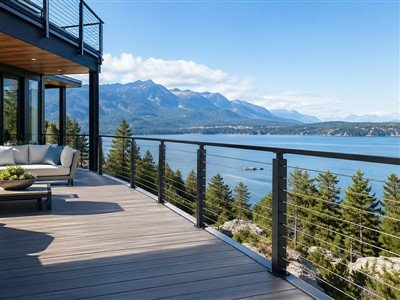
Horizontal cable is a beautiful guard, and on a lakefront deck it frames the horizon perfectly. But to a toddler it can read like a ladder, and that single perception drives more inspection friction than any load number. A handful of municipalities - and entire jurisdictions such as parts of Canada - still restrict or discourage horizontal cable infill on climbability grounds. When that is the constraint, the fastest path to an approved guard is to change the cable direction, not the argument.
That is the whole reason vertical cable exists as a category: same stainless wire, same open view, none of the footholds. The cables now run up and down, so there is no rung to step on, and the guard satisfies the same 4-inch-sphere and 200 lb rules a horizontal system does. Specifiers who deal with families, schools, restaurants or cautious HOAs reach for it specifically because it defuses the conversation before it starts.
What a Vertical Cable Railing Actually Is
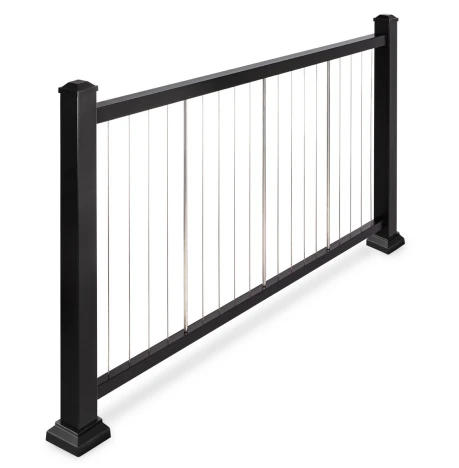
Take the same 1×19 stainless cable and flip the orientation. Instead of tensioning lines between end posts, you hang them between a top rail and a bottom rail. In a factory-built panel the cables are pre-attached to both rails at a fixed on-center spacing, then the whole panel drops between posts like a baluster section. The infill still looks like barely-there stainless lines - it just reads as a picket pattern made of cable, which some architects prefer because it echoes a classic balustrade without the visual bulk.
Vertical vs Horizontal - Read It Side by Side
Neither orientation is "better" in the abstract; they solve different problems. For a specifier, the comparison is the fastest way to decide:
| Aspect | Vertical cable | Horizontal cable |
| Climbability | No horizontal rungs - far harder for a child to use as a ladder. | Reads like a ladder to many parents; invites climbing attempts. |
| Code acceptance | Commonly approved even where horizontals face local limits. | Legal under model codes, but restricted or banned in some municipalities/countries. |
| View pattern | Draws the eye up; frames the view into tall slices. Good into woods. | Emphasizes the horizon; maximizes wide, panoramic feel. |
| Sag & upkeep | Shorter cable segments - less mid-span sag, less frequent retensioning. | Longer runs stretch more; needs retensioning checks. |
| Load path | Carried by the top & bottom rail + support rods. | Carried by the end posts under high tension. |
The short version: choose horizontal when the view is everything and codes allow it; choose vertical when climbability, a local horizontal ban, or a classic-balustrade rhythm is the priority.
How a Vertical System Is Built (Different From a Horizontal One)
The structural story is genuinely different, and it is why vertical is often simpler to get right in the field:
- Top & bottom rails do the work. Because the cables hang between them, the rails - not the end posts - are the primary load members. Both must be rigid extrusions (we use reinforced 6063-T6 aluminum channels) so the panel stays straight under load.
- Pre-assembled panels span the posts. A typical panel runs 6 ft (and up to 8 ft with added support), dropping between posts set no more than ~4 ft on center. Field work becomes "hang the panel, tension, snap the rail caps" rather than threading dozens of loose cables.
- Alignment support rods share the load. This is the detail that separates an engineered vertical system from a cable curtain. Slim stainless support rods sit in line with the cables and quietly carry load, so the cables do not have to. A 6 ft panel typically uses three rods; an 8 ft panel uses five. Ask any supplier how often those members occur and how they were tested - it is the difference between a guard that meets spec and one that just looks the part.
- Set-screw tensioners at the top rail. Tension is applied and adjusted from the top rail with an Allen key; no hydraulic swaging tool on site. Swageless fittings mean a mistensioned line can be re-pulled years later without cutting.
The Engineering Upside of Going Vertical
Here is the part most buyers miss: a vertical cable is under less tension than a horizontal one. With horizontal runs, every line pulls hard on the end posts - ten or more lines at ~225 lb each stacks enormous force on the terminals. In a vertical panel the cables hang between two rails and the tension needed to keep them rigid is lower, so the fittings and rails see less load. The practical payoff is real:
- You can specify thinner 1/8″ cable in a vertical system where you would hesitate to use it horizontally - the reduced tension keeps it code-clean.
- Less force on the hardware means fewer field failures and a longer, quieter service life.
- Shorter cable lengths sag less, so the annual retensioning chore is lighter than with long horizontal runs.
Specification at a Glance
Typical Vertical Cable Specification
| Parameter | Vertical Standard |
| Cable | 316 stainless, 1×19; 1/8″ / 3/16″ / 1/4″ (1/8″ viable thanks to lower tension) |
| On-center spacing | ~3 in (3⅛″) - keeps the 4 in sphere gap closed under load |
| Support rods | Stainless alignment rods in line with cable; 3 per 6 ft panel, 5 per 8 ft panel |
| Post spacing | ≤ 4 ft on center typical; 4–6 ft with reinforced rails |
| Rails | Rigid top & bottom rail (reinforced 6063-T6 aluminum channel) |
| Guard height | 36 in residential · 42 in IBC / commercial · 42 in in CA |
| Load | 200 lb concentrated · 50 lb/ft uniform · 50 lb/sq ft infill |
| Tension | Lower than horizontal runs; set with Allen-key tensioners, re-check annually |
| Frame Finish | AAMA 2604 powder coat; 316 hardware for coastal & pool |

Where Vertical Cable Earns Its Keep
1. Family decks and pools. Where young children are around unsupervised, removing footholds is worth more than a marginally wider view. Many parents specify vertical on instinct alone.
2. Restaurants, schools and HOAs. Commercial and shared-space managers routinely choose vertical because climbability is a liability they would rather not own. It is the "no debate" option at inspection.
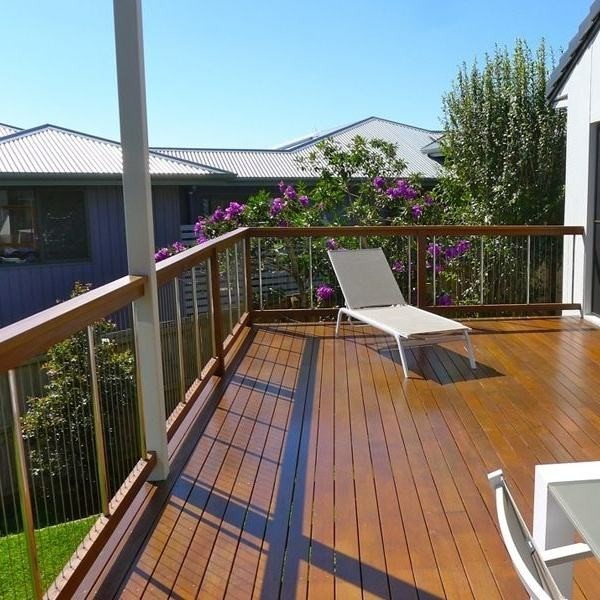
3. Wooded or vertical-view sites. Up-and-down lines echo the trees and posts outside, so the guard blends into a wooded backdrop better than horizontal lines do.
4. Stairs. On a stair run, horizontal cables become convenient footholds; vertical removes them. You still need a separate graspable handrail (1¼–2 in round, continuous, returned) alongside the guard - that rule is identical for every infill type.
Codes: The 4-Inch Sphere, 200 lb, and the Horizontal Ban
Vertical cable is judged by the same performance rules as any guard - it is not a separate standard:
- 4-inch sphere. No opening a 4 in sphere can pass through, including between adjacent vertical cables. We set spacing at ~3 in on center so the gap stays under 4 in even when someone leans on the infill.
- 200 lb / 50 lb per foot. The guard must resist a 200 lb point load and a 50 lb/ft uniform load. The rigid rails and support rods are what deliver this without over-tensioning the cable.
- Local horizontal limits. Where a municipality or country restricts horizontal infill, vertical is usually the straightforward, approvable alternative. Always confirm with the local building department and HOA before ordering - that five-minute call prevents a rejected inspection.
Engineered and Built to Your Drawing
Vertical cable is the one system where "send us a kit" is the wrong instinct - panel lengths, support-rod counts and rail stiffness all interact, so we engineer it from your layout. Send the run lengths, post centers, heights and substrate; we return a panel and post schedule, the cable count and lengths, the support-rod spacing, and the tension and deflection notes your inspector will ask for.
- Direct from the factory. Mill pricing on 6063-T6 frames and 316 cable - no distributor markup on a system this spacing-sensitive.
- Engineering documentation. Post and rod spacing, tension values and deflection calculations supplied for code submission; PE stamp where the jurisdiction requires it, and CAD / shop drawings on request.
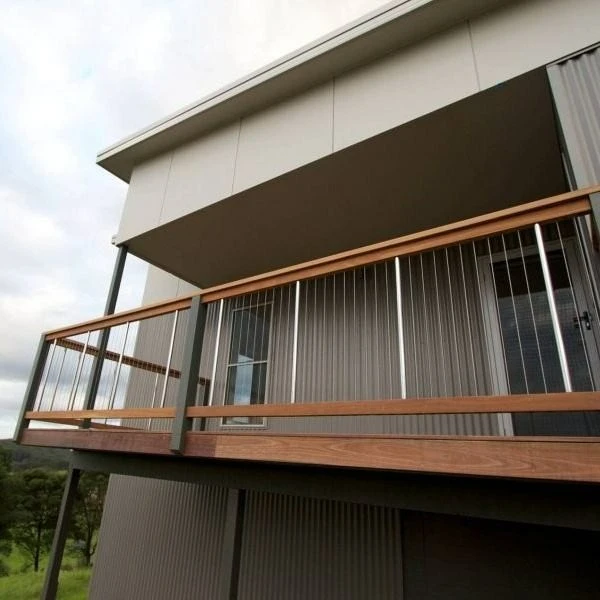
- Built to your dimensions. Panels cut to exact length, pre-drilled and crated per run, so field work is assembly not fabrication. Mix aluminum frames with a wood top rail, or go full metal in standard or custom RAL; coastal and pool orders get 316 hardware by default.
- Shipped worldwide. Small-batch and container loads supported, with freight coordinated to your port.
Send your layout and we quote panels, frames, cable and freight in one line - usually within two business days.
Frequently Asked Questions
Q: Is vertical cable railing safer than horizontal for kids?
A: For climbability, yes. Vertical lines offer no horizontal rungs to step on, so a child cannot use the guard as a ladder the way they might with horizontal cables. Model codes do not ban horizontal infill and correctly built horizontal systems are safe, but the perception and behavior risk is real - and where that matters, vertical removes it. Both orientations still must meet the same 4-inch-sphere and load rules.
Q: Can I use vertical cable where horizontal cable is banned?
A: Often, yes. Some municipalities and countries restrict or discourage horizontal cable on climbability grounds while approving vertical systems, because vertical lines present no ladder. It is never automatic - confirm with the local building department and HOA - but vertical is typically the faster, lower-friction path to approval in those areas.
Q: Do I still need a top and bottom rail with vertical cable?
A: Yes, and they are structural, not decorative. In a vertical system the cables hang between the top and bottom rails, so those rails - not end posts - carry the load. Both must be rigid extrusions (we use reinforced 6063-T6 aluminum channels) and the bottom rail also closes the gap at the deck surface so a 4-inch sphere cannot pass underneath.
Q: Is vertical cable tensioned less than horizontal cable?
A: Yes. Horizontal runs pull hard on the end posts - ten or more lines at roughly 225 lb each stacks enormous force on the terminals. A vertical cable hangs between two rails and needs less tension to stay rigid, so the fittings and rails see lower load. That is why thinner 1/8 inch cable is viable vertically where you might avoid it horizontally, and why vertical needs less frequent retensioning.
Q: How far apart should the vertical cables be spaced?
A: About 3 inches on center (3⅛″ is the common engineered target). The 4-inch-sphere rule requires that no opening a 4-inch sphere can pass through appears even under load, so cables are set tighter than 4 inches to leave a safety margin for any deflection. A 36-inch guard typically carries 12–15 vertical lines.
Q: Does vertical cable cost more than horizontal cable?
A: Little to none. Material and installation cost between the two orientations are close - vertical vs horizontal cable railing generally lands in the same $60–$300 per linear foot range (without labor) depending on frame, finish and span. Vertical can even save field time because pre-assembled panels drop in between posts rather than threading loose cables run by run.
Q: Can vertical cable be used on stairs?
A: Yes, and it is a strong choice on stairs because horizontal cables there become convenient footholds. Vertical removes them. The one rule that does not change is the graspable handrail: a flat top rail is not code-compliant on stairs, so you need a separate round handrail of 1¼–2 inches diameter, continuous with end returns, alongside the cable guard. We design stair panels with that handrail integrated.
Q: Can you make vertical cable railing to my dimensions?
A: That is how we build it. Send run lengths, post centers, heights and substrate and we return a panel/post schedule, cable count and lengths, support-rod spacing and the tension and deflection notes for inspection - with PE stamp and CAD drawings where required. Panels are cut to length, pre-drilled and crated per run for assembly on site. Quote usually in two business days.
Hot Tags: vertical cable railing, China vertical cable railing manufacturers, suppliers, factory, Aluminum Cable Railing System, commercial cable railing systems, Modern Aluminum Cable Railing, Outdoor Cable Railing, outdoor cable railing systems, outdoor deck cable railing systems