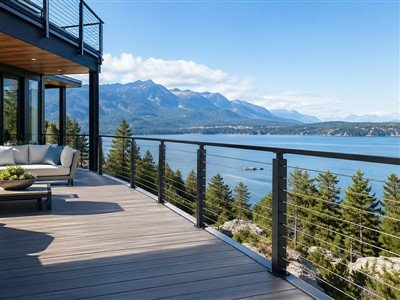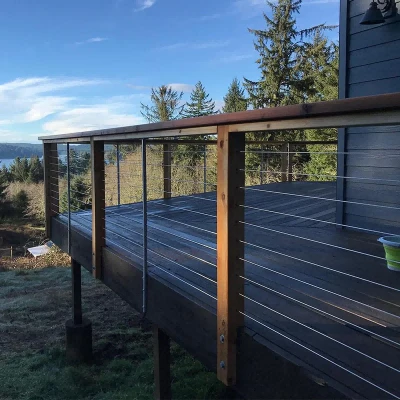
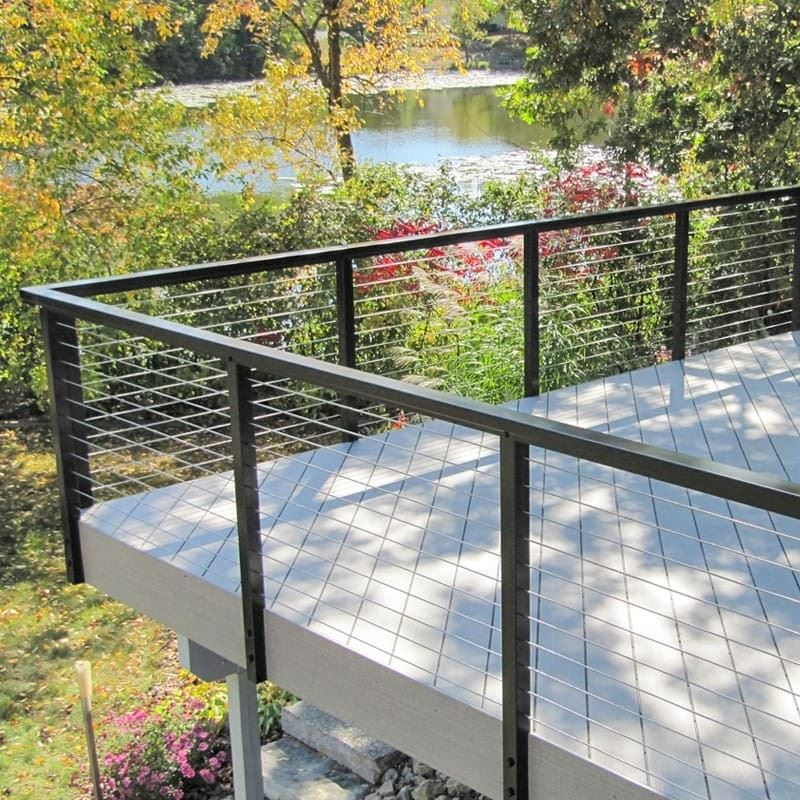
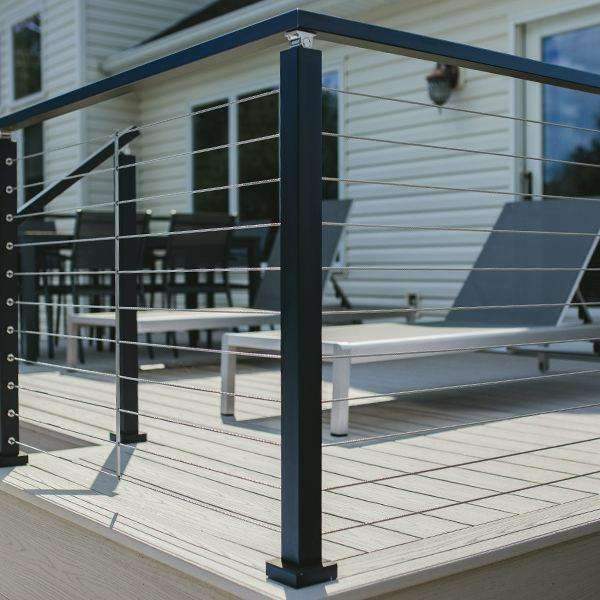
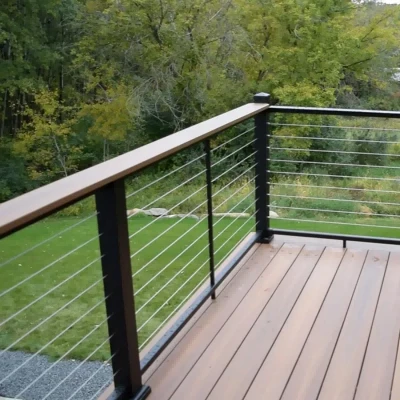
ZP Aluminum Co., Ltd. is one of the most reliable manufacturers and suppliers of steel cable deck railing in China. If you're going to buy bulk high quality steel cable deck railing made in China, welcome to get quotation from our factory. We also accept customized orders.
Steel Cable Deck Railing - Mounted to Wood, Composite & Aluminum Decks
Most cable-deck failures do not start with the cable. They start with a post bolted into a deck board instead of the rim joist behind it. This page is about the deck as the structure: how a cable guard actually attaches to a deck, what the connection must do to pass inspection, and how we engineer the whole run to your deck's framing - wood, composite or aluminum. Cable material (1×19, 316, diameter) lives on our Steel Cable Railing page; horizontal and vertical run geometry on the Horizontal and Vertical Cable Railing pages.

Pick the right page for your question
Specifying the cable itself (diameter, 1×19, 316 vs 304)? Go to Steel Cable Railing.
Designing a horizontal or vertical run (post moments, spacing)? See Horizontal or Vertical Cable Railing.
Choosing aluminum vs steel for the frame? See Metal Cable Railing.
Comparing cable against glass and picket on a deck? See Deck Railing System.
Mounting cable to a deck and meeting deck code? You are in the right place.
The Deck Is the Structure
A deck is something you stand on; a cable guard is something bolted to its edge. The guard only performs if the edge performs. The cable is the easy part - it is the post-to-deck connection that carries every pound of guard load and every ounce of cable tension into the framing. A clean, tensioned cable line on a deck that wobbles at the post is not a cable problem; it is a connection problem. That is why a deck-mounted cable system is engineered from the substrate up, not shipped as a generic kit.
Surface Mount vs Fascia Mount - the Two Ways Cable Lands on a Deck
Cable posts reach a deck one of two ways, and the choice shapes the whole job:
| Surface mount (top of deck) | Fascia mount (side of rim joist) | |
| Where it sits | Post base on the deck boards, bolts run down into framing. | Post or bracket on the vertical face of the rim joist, beside the deck edge. |
| Deck space | Uses a little of the deck-edge footprint. | Frees the full deck surface - posts sit off the walking plane. |
| Drainage | Through-bolts pierce the decking; must be sealed. | No penetration of the walking surface - better over a waterproof membrane or second-story balcony. |
| Retrofit | Forgiving; works on existing decks without touching the rim. | Needs sound, accessible rim joist; great when framing is planned during the build. |
| Difficulty | Simpler, top-down access. | Needs precise alignment on the vertical face; often reinforced. |
On a composite deck, fascia mount is the common pick because the hidden fastener field stays clean and the post hangs off the edge rather than through the cap board. On a wood deck with open framing below, surface mount is the faster, more forgiving path. The right answer follows your deck's framing, not a catalogue default.
Making the Connection Hold
This is the part the building department checks, and the part that decides whether the run stays straight for thirty years. A post must transfer both the guard load and the cable's pull-back tension into solid wood or metal - never into a single deck board.
- Surface mount needs backing. Under every surface post, add a double 2×6 (or 3 in material) blocking laid flat, fastened to the joists on all four sides. The deck board alone carries nothing.
- Fascia mount needs depth. The rim joist at a side-mount post should be a double 2×8 (or 3 in stock) at least 7.5 in tall. Where it isn't, we specify a steel bracket or added blocking so the cantilevered load has something to bite.
- End and corner posts carry the most. They take the full cumulative cable tension (typically 200–300 lb per cable), so they get the largest section and the fullest fastener pattern - never a two-screw shortcut.
- Anchor grade. Through-bolts into the framing, stainless or galvanized; coastal work is 316 throughout, not just the cable.
Pairing Cable with Your Deck Material
Cable is the most deck-agnostic infill there is - thin stainless lines disappear against any surface - but the post and finish should be chosen to sit with the deck:
- Wood deck. Aluminum posts with a wood top rail give the modern-farmhouse look; full metal reads more contemporary. The post base still lands on blocking, not the boards.
- Composite deck. Fascia mount keeps the cap board clean; a composite-sleeved wood post is an option where the look calls for it. We match the powder-coat color to the deck line.
- Aluminum deck framing. 6063-T6 or 6061-T6 posts, anodized or powder-coated, bolt straight to the aluminum structure - one corrosion class end to end, no dissimilar-metal surprise.
Finishes run matte black, textured white, bronze and weathered brown as standards, with custom RAL on request. Coastal and poolside decks spec AAMA 2605, the superdurable grade validated against ASTM B117 salt-spray.
Deck Height, Stairs and the Guard Code
A deck guard is a safety device first, so the numbers are not optional. These are the IRC/IBC baselines - always confirm the local amendment, because some jurisdictions (California, New York City) require 42 in even on homes:
- Trigger. A guard is required once the deck surface is more than 30 in above grade (some states 24 in). Below that, none is mandated - though many owners fit one anyway.
- Height. 36 in residential (IRC R312), 42 in commercial / IBC. Measure from finished deck surface to the top of the rail.
- Opening limit. No 4 in sphere passes anywhere - between cables, and between the bottom cable and the deck. Stair triangles get a 6 in exception.
- Load. 200 lb concentrated at any point, plus 50 lb per foot uniform, in any direction.
- Stairs. A separate graspable handrail 34–38 in above the nosing, with a 1¼–2 in diameter profile; the cable follows the stair pitch but does not act as the handrail.
Cable Spacing and Tension on a Deck
On a deck the cable runs are usually long and the view matters, so spacing and tension are where the engineering shows:
- 3 in on-center spacing. Recommended to keep deflection inside the 4 in sphere under the 200 lb load - closer than the raw code minimum, and what lets a deck read as one clean line.
- Post spacing 4–6 ft. Posts land on joists or blocking; engineered aluminum reaches 8 ft on-center on a stiff frame.
- End-post load. Each cable pulls 200–300 lb back to the anchored ends; we size the end posts and the tensioners for that, not for a brochure number.
- Tension. Center-out, to ~200–300 lb per cable, checked after the deck's first seasonal move.
Typical Steel Cable Deck Railing Specification
| Parameter | Standard |
| Post / frame | Aluminum 6063-T6 (steel on request) |
| Finish | AAMA 2604 powder coat (AAMA 2605 coastal) |
| Mount | Surface or fascia; wood / composite / aluminum deck |
| Backing | Double 2×6 blocking (surface) / double 2×8 rim (fascia) |
| Cable | 316 stainless 1×19 - full detail on Steel Cable Railing |
| Cable spacing | 3 in on-center (deflection-controlled) |
| Post spacing | 4–6 ft; up to 8 ft engineered |
| Guard height | 36 in residential · 42 in IBC / commercial |
| Load | 200 lb concentrated · 50 lb/ft |
| Code | IRC R312 / IBC 1015 |
| Stairs | Separate graspable handrail 34–38 in |
Cable diameter, break strength and tension hardware are on the Steel Cable Railing page; run orientation and post-moment engineering on the Horizontal and Vertical Cable Railing pages.


Engineered to Your Deck Layout
A deck cable system is drawn from your deck, not pulled from a box. Send the deck plan, joist direction, post positions, heights and substrate; we return a post-and-blocking schedule, the cable count and lengths, the tensioner list, and the load-and-deflection notes your inspector will ask for - with PE-stamp support where the jurisdiction requires it.
- Blocking planned, not guessed. We mark exactly where backing goes under surface posts and where the rim needs doubling for fascia posts, so the crew is not improvising.
- Cut to your layout. Posts are drilled to your cable count and crated per run; field work is assembly, not fabrication.
- Mixed materials. Aluminum posts with a wood or composite cap, full metal, or a hybrid - finished to match the deck line, 316 hardware by default near water.
- Direct from the factory. Mill pricing on frame and 316 cable; small-batch and container loads both supported; quoted usually within two business days.
Frequently Asked Questions
Q: Can I put cable railing on my existing wood deck?
A: Yes, in most cases. Surface mount is the forgiving retrofit: posts bolt down through the decking into added blocking, and you do not have to touch the rim joist. The deck m ust be sound - no rot at the edge - and the posts need solid backing underneath, not just the boards. Fascia mount works too if the rim joist is accessible and strong enough, or can be reinforced.
Q: Surface mount or fascia mount - which is better for a deck?
A: It follows the deck. Surface mount is simpler and better for retrofits and existing decks; it costs a little edge space and needs sealed through-bolts. Fascia mount frees the full deck surface and never pierces the walking plane, so it is the default over a waterproof membrane or second-story balcony - but it needs a sound, often doubled, rim joist and more precise alignment.
Q: Do I need to add blocking to the rim joist?
A: For surface mount, yes - every post needs a double 2×6 (or 3 in) blocking laid flat and tied to the joists on all four sides; the deck board alone carries no guard load. For fascia mount, the rim joist at the post should be a double 2×8 (or 3 in stock) at least 7.5 in tall, or be reinforced with a bracket or added blocking. We show the exact locations on the schedule we return.
Q: How high does a deck cable railing need to be?
A: 36 in above the finished deck surface for a residential deck (IRC R312), 42 in for commercial or IBC-governed decks. A guard is required once the deck is more than 30 in above grade in most jurisdictions - some states and cities (California, NYC) require 42 in even on homes, so check the local amendment. Measure from the deck surface to the top of the rail.
Q: Will cable railing work on composite decking?
A: Yes. Fascia mount is common on composite decks because it keeps the cap board and hidden fastener field clean; surface mount works where the substrate is reinforced and the bolts are sealed. A composite-sleeved wood post is an option for a matched look. We powder-coat the posts to the deck line and spec 316 hardware near water.
Q: Can cable railing follow deck stairs?
A: Yes - the cable runs at the stair pitch, but the cable is not the handrail. Code requires a separate graspable handrail 34–38 in above the stair nosing with a 1¼–2 in diameter profile. We lay out the stair posts, the pitched cable runs and the handrail together so the whole flight reads as one system.
Q: How far apart should the posts be on a deck?
A: Typically 4–6 ft on center so each post stays within load; engineered aluminum reaches 8 ft on a stiff frame. Posts must land on a joist or blocking, not between them. Closer spacing also keeps cable deflection tighter, which is why we recommend 3 in cable spacing to hold the 4 in sphere rule under load.
Q: Is 316 cable necessary for a deck near a pool or the coast?
A: For any deck within roughly 10 miles of salt water, or around a chlorinated pool, 316 stainless is the baseline for the cable and all hardware - 304 or plain aluminum will tea-stain and pit. Pair it with an AAMA 2605 superdurable powder coat on the posts. Inland, dry-climate decks can step down, but we default coastal and poolside orders to 316 end to end.
Q: Does a deck cable railing need a permit?
A: In most jurisdictions, yes - a guard on a deck over 30 in is a structural change that needs a permit and inspection, and the inspector will check post connection, blocking, height, the 4 in sphere and the 200 lb load. Engineered systems with an evaluation report (e.g., ICC-ES) and our load-and-deflection drawings move that inspection along; we supply the documentation your jurisdiction asks for.
Hot Tags: steel cable deck railing, China steel cable deck railing manufacturers, suppliers, factory, Aluminum Cable Railing System, Black Aluminum Cable Railing, Modern Aluminum Cable Railing, Outdoor Aluminum Cable Railing, outdoor deck cable railing systems, Residential Aluminum Cable Railing