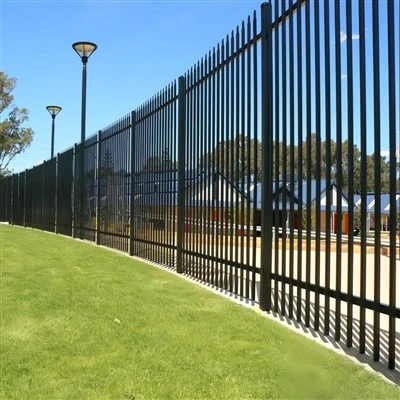
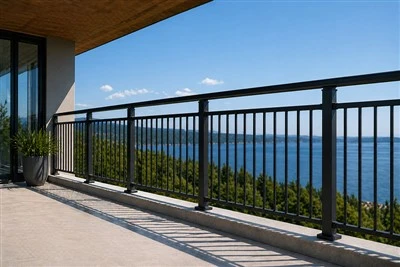
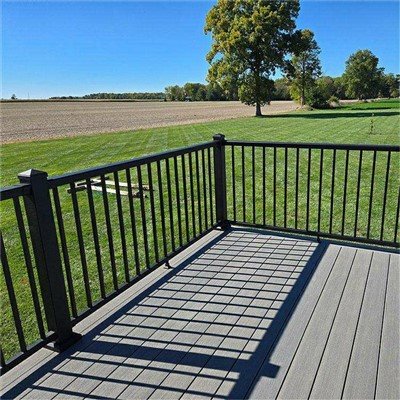
ZP Aluminum Co., Ltd. is one of the most reliable manufacturers and suppliers of coastal marine grade aluminum railing in China. If you're going to buy bulk high quality coastal marine grade aluminum railing made in China, welcome to get quotation from our factory. We also accept customized orders.
Coastal Marine Grade Aluminum Railing
- 316 Hardware, ASTM B117 Salt-Spray
A salt-proof guard built from chloride-resistant alloys and thick walls, fastened only with 316 stainless, drained so water cannot trap, and proven by salt-spray testing - engineered for oceanfront decks, docks, piers, marinas and saltwater pools.

"Marine grade" is not a coating option you tick at checkout - it is a set of material and detailing decisions that decide whether an aluminum railing survives ten years of salt air or pits through in three. A coastal marine grade aluminum railing is built from alloys and wall sections chosen for chloride resistance, detailed so water cannot sit in crevices, fastened only with 316 stainless hardware, and proven by salt-spray testing rather than claimed by a slogan. This page is about specifying that rail for oceanfront decks, docks, piers, marinas, beach houses and saltwater pools - the alloy, the wall, the test, and the engineering that keeps a guard intact where ordinary aluminum fails.
What "Marine Grade" Actually Means
There is no single ASTM number that says "marine grade aluminum." What buyers should mean by it is a combination of four choices:
| Decision | Standard rail | Marine-grade rail |
| Alloy | 6063-T5 (cheaper tempers) | 6063-T6 or 6061-T6;5xxx for welded marine parts |
| Wall thickness | 0.080 in (2.0mm) | 0.125 in (3.2mm) minimum on exposed sections |
| Hardware | Mixed / 304 stainless | 316 stainless throughout |
| Proof | None stated | Salt-spray tested, records kept |
We extrude 6063-T6 as the primary hollow profile because it finishes cleanly and holds tight tolerances, and we use 6061-T6 where a section carries structural load (long spans, gate frames). Where a part is welded - stringers on a dock rail, for example - we move to a 5xxx-series alloy or a 6xxx with weld-grade temper, because those hold corrosion resistance through the heat-affected zone instead of losing it at the weld.
Proving It - Salt-Spray Testing
The honest way to claim marine performance is a salt-spray (fog) test, not a marketing word. We run coated and bare assemblies to ASTM B117, holding a 5% neutral salt fog at 35 °C, and read the panels at 1,000 / 3,000 / 5,000 hours:
- A quality conversion-coated and 2605-finished section shows no creep from scribe and no pitting at 3,000 h; we target clean-to-5,000 h on marine runs.
- Bare cut ends and fastener recesses are the weak point, so those are tested deliberately - capped, sealed, or bagged with a corrosion inhibitor and re-checked.
The cycle is documented, not promised: every marine order ships with the coating class, film thickness and the salt-spray result on the material certificate. If a buyer cannot show you that record, "marine grade" is a label, not a specification.
The Three Corrosion Threats at the Coast - and How We Counter Them
Salt changes the failure mode. Three mechanisms matter:
1. Pitting. Chloride ions attack the passive film and bore small pits that, given time, eat through a thin wall. We counter this with thicker minimum walls (0.125 in), a complete conversion-coat layer under the powder, and 2605 fluoropolymer at the coast - polyester chalks and then pits faster.
2. Crevice corrosion. Water trapped where two surfaces meet (an un-capped post base, a sealed but un-drained joint) goes anaerobic and eats the metal. Our rails use weep holes and drained post bases, sealed end caps that still breathe, and open-profile geometry so water cannot pool.
3. Galvanic (dissimilar-metal) corrosion. Aluminum next to carbon steel or even the wrong stainless will corrode as the anode. We fasten exclusively with 316 stainless (molybdenum-bearing, chloride-resistant) and insert dielectric isolation washers wherever aluminum meets steel, concrete embed or a dissimilar fitting.
Hardware: 316 Stainless, Nothing Less
The rail is only as marine-proof as its smallest screw. At the coast we specify:
- 316 stainless bolts, anchors, set screws and caps - not 304, which lacks molybdenum and pits in chlorides.
- Chemical (not expansion) anchors into salt-exposed concrete, with a stainless or coated sleeve so the anchor line does not become the corrosion path.
- Dielectric isolation at every aluminum-to-steel or aluminum-to-composite contact so no galvanic cell forms.
Engineering for Coastal Wind and Exposure
Coastal and open-water sites are windier and the rail is more exposed, so the guard has to be detailed for it:
- Wind / line load. We design to the same 200 lb (0.89 kN) point and 50 lb/ft (0.73 kN/m) line load per IBC 1015 / IRC R312, then tighten post spacing to 4 ft (1.2 m) on exposed runs and increase wall where the span is open to the sea.
- Deflection. Top-rail deflection held within L/60 under load, verified with load-and-deflection notes.
- 4 in sphere rule. Baluster spacing and the under-rail gap both clear the 4 in (100 mm) sphere; wind-driven spray does not change the geometry.
- Anchoring. Base plates to wood (through-bolt + sealed washer) or concrete (≥4 in / 100 mm, chemical anchors); core-drilled shoes for a flush deck surface on docks and piers.
We issue CAD / shop drawings and load-and-deflection notes with PE-stamp support where the jurisdiction requires sealed calculations, to IBC, IRC, BS 6180 or AS/NZS 1170 - so a marine rail is documented for the permit, not just built for the view.
Where It Goes - Marine & Coastal Applications
This is the rail for environments that end ordinary aluminum:
- Oceanfront decks and balconies within sight of the water, where salt spray is a daily load.
- Docks, piers and marina gangways - wet, briny, and walked on; 5xxx welded sections and drained geometry.
- Beach houses and seawalls exposed to wind-driven salt.
- Saltwater and chlorinated pools - chlorine is a chloride too, and the barrier must be 48 in (1200 mm) with self-closing gates.
- Rooftop terraces in coastal cities - high UV plus salt air in one package.


Typical Marine Specification
| Parameter | Marine-grade standard |
| Alloy | 6063-T6 (6061-T6 structural; 5xxx welded parts) |
| Wall thickness | ≥ 0.125 in(3.2mm) no exposed sections |
| Coating | AAMA 2605 (PVDF) over chrome-free conversion coat |
| Salt-spay proof | ASTM B117, clean to 3000 h, target 5000 h |
| Hardware | 316 stainless throughout |
| Isolation | Dielectric washers at dissimilar-metal contact |
| Drainage | Weep holes, drained post bases, no trapped water |
| Components | Posts · top/bottom rails · balusters · hidden fasteners |
| Height | 36″ residential · 42″ IBC · 48″ pool |
| Baluster spacing | ≤ 4 in (100 mm) sphere rule |
| Post spacing | 4 ft (1.2 m) on exposed coastal runs |
| Load | 200 lb point · 50 lb/ft (IBC 1015 / IRC R312) |
| Deflection | ≤ L/60 at top rail |
| Anchoring | Chemical anchors in concrete; through-bolt to wood |
| Engineering | CAD drawings · load-deflection notes · PE stamp on request |
Request a Quote or Sample
Tell us the site (distance to open water, pool or both), the run length and layout, required height (36 / 42 / 48 in), color, and whether posts are surface-mounted or through-deck. We return a quote with alloy, wall, coating class, salt-spray result, lead time and - where needed - sealed calculations, usually within two business days. A coated and fastened sample section is available so you can verify the finish and the 316 hardware before a full order.
Frequently Asked Questions
Q: What makes an aluminum railing "marine grade"?
A: Not a coating alone - it is the alloy (6063/6061-T6, 5xxx for welds), a thicker minimum wall (0.125 in), 316 stainless hardware, drainage that stops water trapping, and a salt-spray test record. Any one of those missing and it is just aluminum near the sea.
Q: Is 316 stainless hardware really necessary, or is 304 fine?
A: At the coast, 316. The 2–3% molybdenum in 316 is what resists chloride pitting; 304 lacks it and pits in salt air. The hardware is the smallest, most exposed part, so it determines how long the rail stays tight.
Q: How long does a marine grade aluminum railing last?
A: With 2605 over a conversion coat, 316 hardware and proper drainage, 15–25 years of service color and structural integrity is realistic in salt exposure; the aluminum itself does not rust, so failure is slow and cosmetic unless water is trapped or the wrong metal is used.
Q: Will the powder coat survive salt spray?
A: AAMA 2605 fluoropolymer over a chrome-free conversion layer survives where polyester chalks and pits. We prove it with ASTM B117 salt-spray testing and ship the result on the material certificate rather than stating a claim.
Q: Do you make railings for docks and piers?
A: Yes - wet, briny, walked-on runs use 5xxx-series welded sections and drained geometry so water cannot pool in the profile, with 316 hardware and chemical anchors into the deck structure.
Q: Can you supply engineering for permits?
A: Yes - CAD / shop drawings, a post-and-baluster schedule, and load-and-deflection notes, with PE-stamp support where your jurisdiction requires sealed calculations, to IBC, IRC, BS 6180 or AS/NZS 1170.
Hot Tags: coastal marine grade aluminum railing, China coastal marine grade aluminum railing manufacturers, suppliers, factory, black aluminum deck railings, modern residential aluminum railings, outdoor aluminum powder coated railing, powder coated aluminum deck railing, powder coated aluminum handrail, residential aluminum balcony railing