ZP Aluminum Co., Ltd. is one of the most reliable manufacturers and suppliers of deck railing system in China. If you're going to buy bulk high quality deck railing system made in China, welcome to get quotation from our factory. We also accept customized orders.
Deck Railing System - Aluminum Picket, Glass & Cable
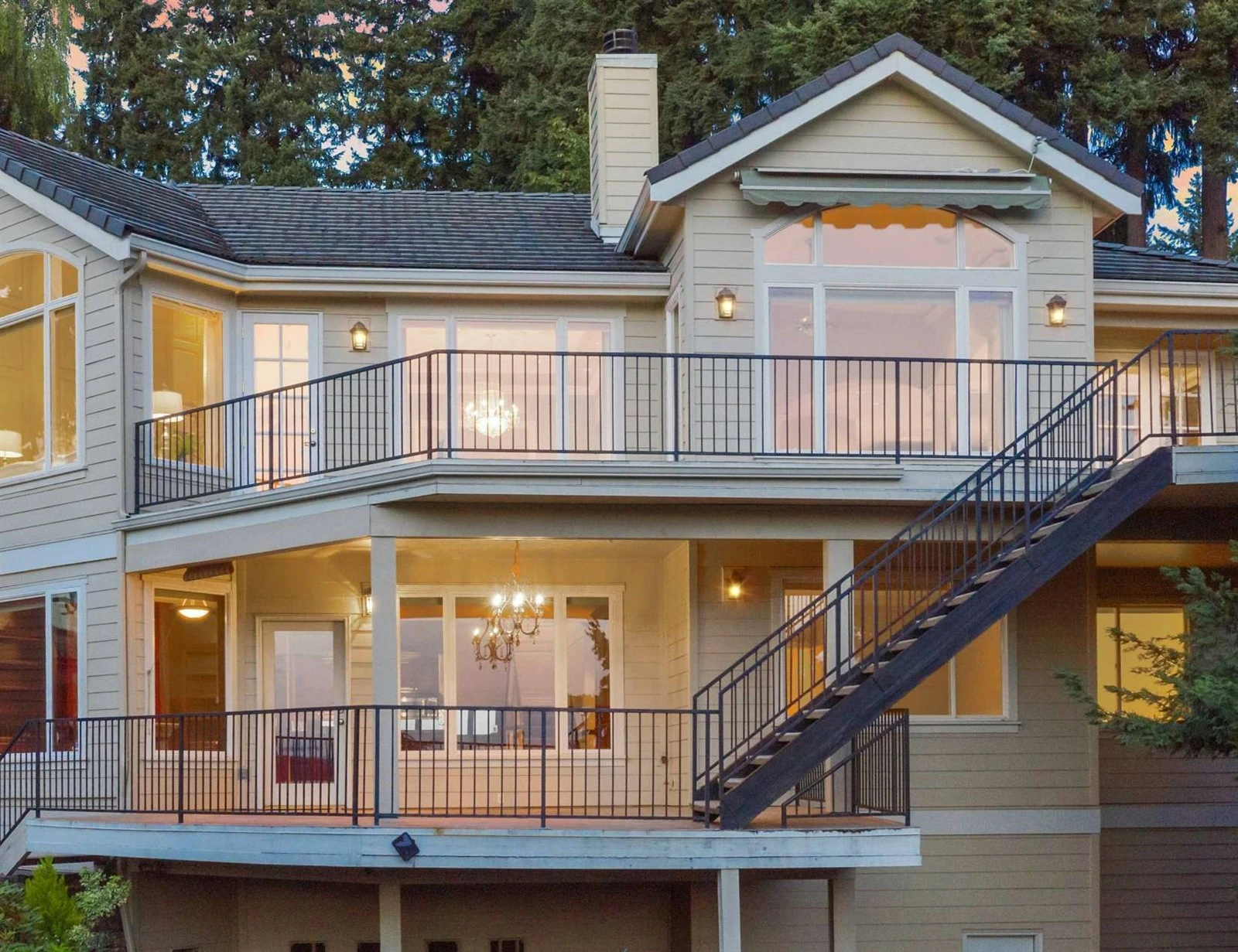
What Is a Deck Railing System?
A deck railing system is the full guard assembly that runs around the open edge of a raised deck or balcony - posts, top and bottom rails, and the infill between them (pickets, glass, or cable). Its job is twofold: stop people from falling, and finish the look of the outdoor space. For most homes, a guard is legally required once the deck surface sits more than 30 inches (about 760 mm) above the ground.
We build the structural frame - posts, rails and brackets - from aluminum, then let you choose the infill. That gives you the low-maintenance backbone of metal with whatever aesthetic you want on top, and it is the same platform our glass balustrade and pool-fence products are built on.
Aluminum vs. Other Railing Materials
The fastest way to see why aluminum dominates quality decks is a straight cost-and-life comparison. Numbers below are typical installed prices in North America; your region will vary.
| Material | Lifespan | Upkeep |
| Pressure-treated wood | 5-10 yrs | Stain/paint every 2-3 yrs |
| Clear | 10-15 yrs | Regular sealing |
| Vinyl / PVC | 20-25 yrs | Low, can go brittle in cold |
| Composite | 25-30 yrs | Low, may fade in UV |
| Aluminum (ours) | 25+ yrs | Annual wash only (seaside 10-15 yrs) |
Wood is cheapest up front but the most expensive over time - staining, rot, and full replacement inside 10–15 years. Aluminum costs a bit more at the start and then asks almost nothing of you for three decades. Over a 20-year window, aluminum usually beats wood on total cost.
Why aluminum is the low-maintenance winner
- Does not rust. Rust is an iron-oxide reaction; aluminum has no iron. It forms a thin oxide skin that protects it, and powder coating doubles that protection.
- Won't rot, warp, crack or attract insects - the failures that kill wood and even some composites.
- Factory-set baluster spacing. With manufactured aluminum, picket gaps are code-compliant at the factory, so there is no on-site measuring or 4-inch-ball guesswork.
- Lightweight and easy to handle, which keeps install labor down and makes it DIY-friendly on straight runs.
- 100% recyclable and available in far more colors than wood.
Infill Options: Picket, Glass & Cable
All three sit in the same aluminum frame. Pick the one that matches your view, budget and upkeep preference.

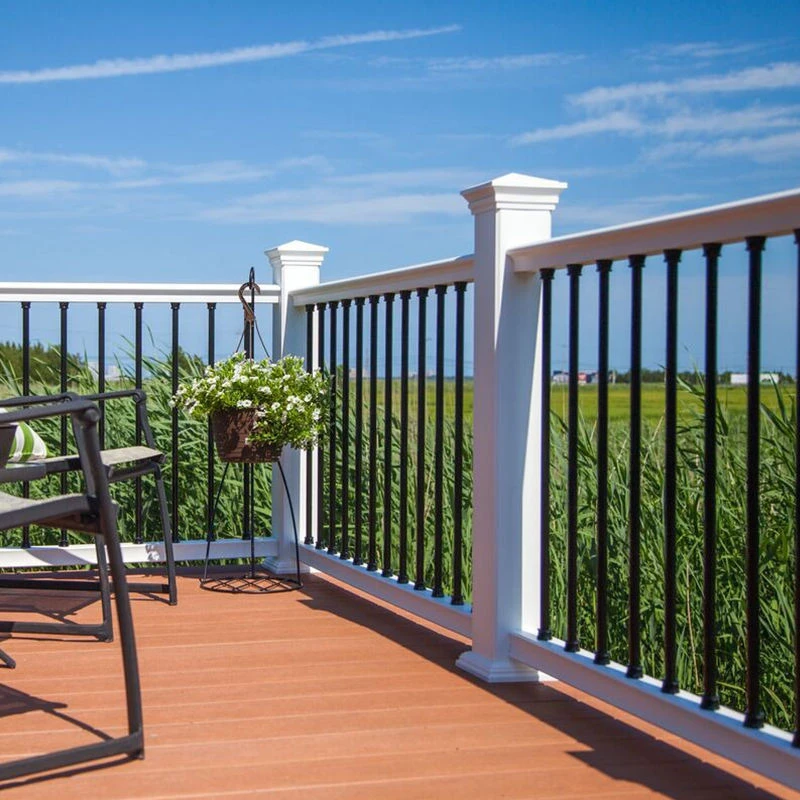
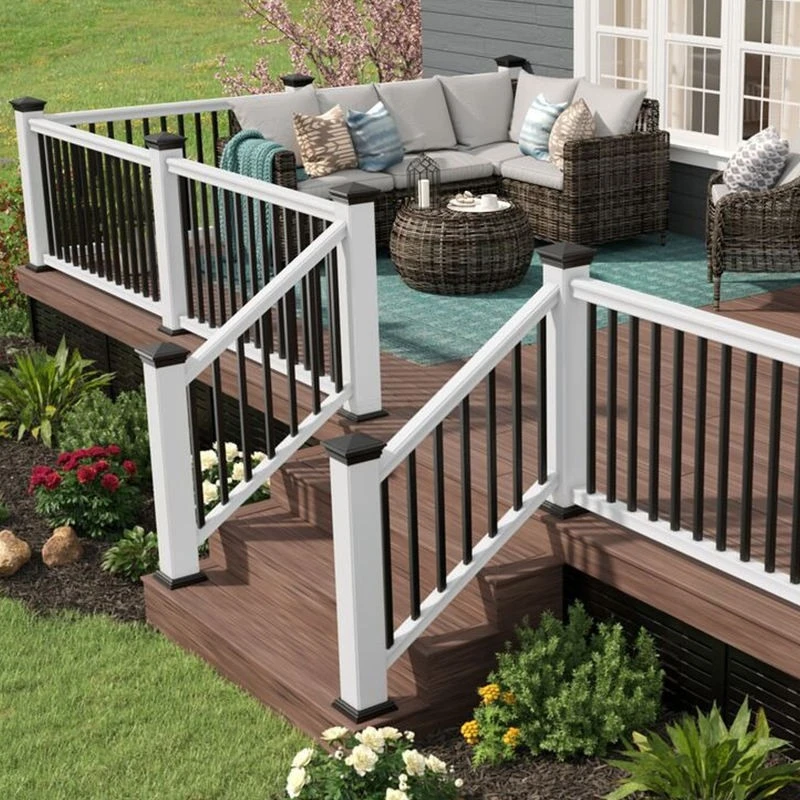
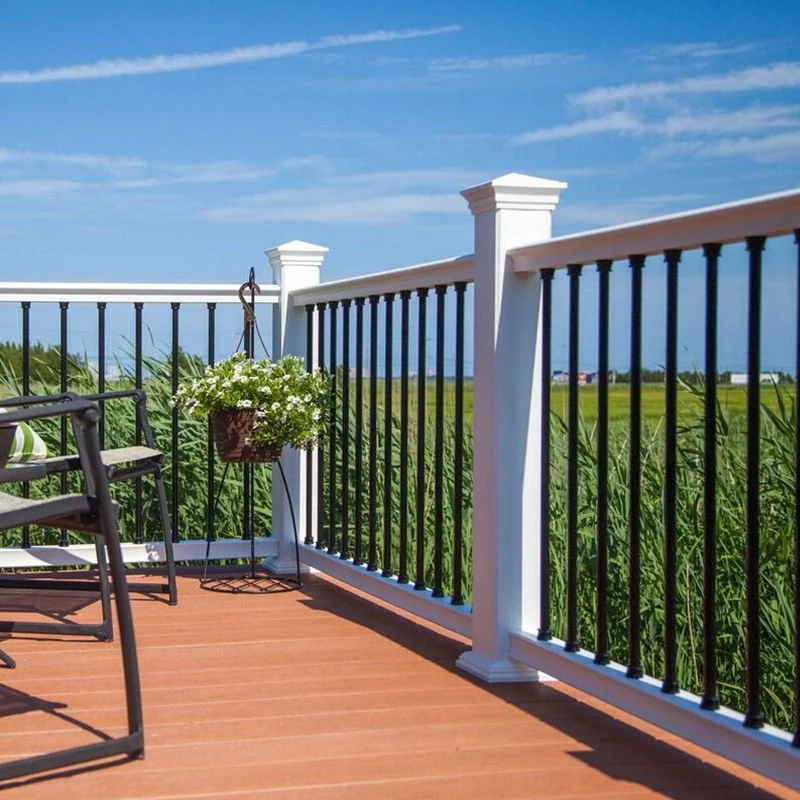
Aluminum picket (baluster) railing
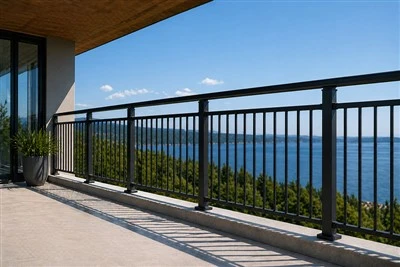
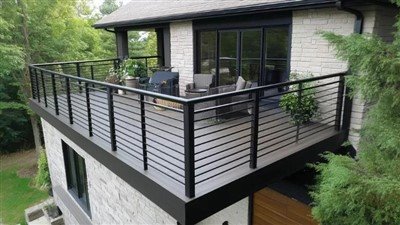
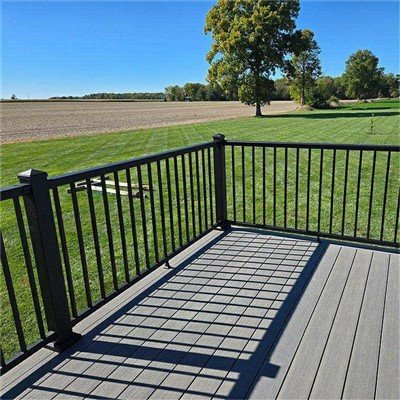
The workhorse and our most-requested option. Vertical square or round aluminum balusters between a top and bottom rail. Clean, classic, child-safe by default, and the best value. Best when the view is not the headline feature and you want the railing to quietly disappear into the background.

Glass-panel railing
Tempered-laminated glass infill in an aluminum frame (or frameless base shoe) opens the sightline completely - ideal for lake, ocean or city views. More cleaning than pickets, more cost, but strong resale value on view properties. (See our External Glass Balustrade page for the full spec.)

Cable railing
Thin stainless cables through aluminum posts give a near-clear view at lower cost than glass. The catch: cables need periodic tensioning, and some jurisdictions restrict horizontal cable because it can act as a climbing foothold for children. Confirm with your local inspector before ordering cable.
Deck Railing Building Code & Safet
Codes vary by country and municipality, so confirm with your local building department. The principles are consistent, and they come down to height, opening size, and load.
Key code points (reference: IRC / IBC, also mirrored in NBC for Canada)
When a guard is required: deck surface more than 30″ (760 mm) above grade in the US; 24″ (600 mm) in Canada.
- Height: 36″ (914 mm) residential minimum; 42″ (1067 mm) for commercial/IBC and many elevated or high-wind decks. Measure from the deck surface to the top of the rail.
- The 4-inch sphere rule (IRC R312.1.3): no opening - between balusters, under the bottom rail, or between the last baluster and the post - may let a 4″ sphere pass. On stairs the baluster gap may reach 4⅜″. Keep the bottom rail within 4″ of the deck surface.
- Loads: guards must resist a 200 lb (0.89 kN) concentrated load at the top edge and, under IBC, a 50 plf (0.73 kN/m) uniform horizontal load.
- Post spacing: commonly 6 ft on-center for residential; engineered aluminum panel systems can span up to 8 ft. Ask for the engineering documentation - spacing is a system property, not a single code number.
- Stairs: need a continuous, graspable handrail 1.25″–2″ diameter, 34″–38″ above the stair nosing.
We ship manufactured aluminum systems with code-compliant baluster spacing and, on request, an engineering certification letter so your inspector can sign off quickly. We never recommend a system we cannot document to code.
Specifications & Customization
- Alloy & finish: 6063-T6 (or 6005-T61 for structural posts) aluminum extrusions, AAMA 2604-grade architectural powder coat over pretreated surfaces - holds 20+ years.
- Color: any RAL color - matte black, white, bronze, coastal grey, or a custom match to your decking and window frames.
- Heights: 36″ standard, 42″ on request; custom heights for commercial or local amendments.
- Baluster spacing: set at the factory to meet the 4″ sphere rule, with a safety margin (typically ~3.5″ clear).
- Post spacing: engineered spans up to 6 ft (picket) / 5 ft (glass); we supply the tested maximum for your exact profile.
- Infill: aluminum picket, tempered-laminated glass panel, or stainless cable - mixed on the same deck is common and cost-effective.
- Hardware: 316 stainless where coastal; structural fasteners rated for shear, not deck screws.
- Cut-to-size: send run lengths, heights, corners and stair flights; we CNC-cut and drill before shipping.
Why Order Deck Railing From ZP Railing
We are the manufacturer, not a reseller, which changes three things for your project:
- Direct price & lead time - the extrusion line connects straight to your container.
- Real customization - non-standard heights, radii, mixed infill and color matches are normal, not "special requests."
- Engineering backup - load data and certification letters so your permit and inspection go through the first time.


Our aluminum is extruded to 6063-T6, powder-coated in a controlled line, and QC-checked before it leaves the factory. We supply distributors, contractors and builders across North America, Europe, the UK and Australia, and we ship full systems or replacement components.
Request a Quote or Samples
Tell us the deck perimeter length, height (36″ or 42″), infill choice (picket / glass / cable, or a mix), number of corners and any stairs. Attach a sketch and we return a quote with specifications and lead time - usually within 2 business days. Sample posts, balusters and color chips are available on request.
Frequently Asked Questions
Q: How tall does a deck railing need to be?
A: Residential decks require a minimum of 36″ (914 mm) from the deck surface to the top of the rail. Commercial buildings and many elevated or high-wind residential decks require 42″ (1067 mm). A few jurisdictions (e.g. parts of California and New York) mandate 42″ for homes too. Always measure from the highest walkable surface.
Q: What is the 4-inch sphere rule for balusters?
A: Per IRC R312.1.3, no opening in the guard - between balusters, under the bottom rail, or between the last baluster and a post - may allow a 4-inch sphere to pass through. It is a child-safety rule. With our manufactured aluminum pickets the spacing is set at the factory (≈3.5″ clear) so it passes without on-site measuring.
Q: How far apart should deck railing posts be?
A: For most residential systems, 6 feet on-center is the standard. Engineered aluminum panel systems can span up to 8 feet between posts. Post spacing is a property of the specific system's load testing, not a single code number - we supply the tested maximum for the profile you order.
Q: Does aluminum deck railing rust?
A: No. Rust only affects iron and steel. Aluminum forms a protective oxide layer and does not rust; with a quality AAMA 2604 powder coat (and 316 stainless hardware near the coast) the structure lasts 30+ years with just an occasional wash.
Q: Is aluminum railing better than wood?
A:For durability and upkeep, yes. Aluminum lasts 30+ years with no staining, painting or replacement, while wood needs refinishing every 2–3 years and often full replacement within 10–15 years. Wood is cheaper up front; aluminum is cheaper over the life of the deck.
Q: Can I install the railing myself?
A: Often, yes. Manufactured aluminum arrives pre-assembled or in panelized sections, so there is no cutting individual pickets or measuring spacing on site. Straight runs are very DIY-friendly with basic tools; stairs, corners and frameless glass are where most people bring in a pro. We include install guides and engineering docs.
Q: Do I need a permit for deck railing?
A: Railing on a new deck is usually covered by the deck permit. Replacing railing on an existing deck may or may not need its own permit depending on the municipality. A five-minute call to your local building department is cheaper than a failed inspection - and we can supply the certification letter inspectors ask for.
Q: What colors and infills can I choose?
A: Any RAL powder-coat color - matte black, white, bronze and custom matches are standard. Infill can be aluminum picket, tempered-laminated glass panel, or stainless cable, and you can mix them on one deck (e.g. glass on the view side, pickets elsewhere) to control cost.
Hot Tags: deck railing system, China deck railing system manufacturers, suppliers, factory, frameless aluminum balcony railing, home deck railing, Modern Outdoor Deck Railing, outdoor deck glass railing, powder coated aluminum balcony railing, powder coated railing systems