ZP Aluminum Co., Ltd. is one of the most reliable manufacturers and suppliers of metal railing with pickets in China. If you're going to buy bulk high quality metal railing with pickets made in China, welcome to get quotation from our factory. We also accept customized orders.
Metal Railing with Pickets:
Aluminum & Steel Baluster Guards for Decks, Balconies & Stairs
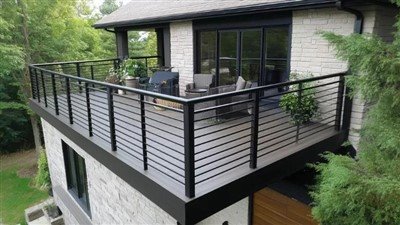
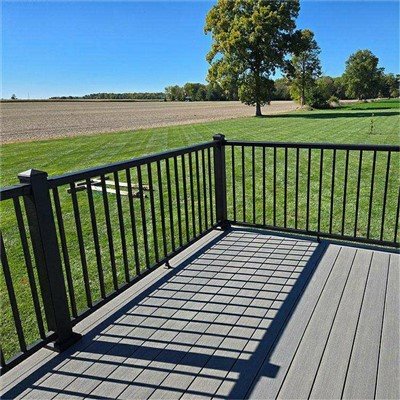
A metal railing with pickets puts vertical balusters between a top and bottom rail - the classic, climb-proof guard for any surface more than 30″ above the ground. Where cable can deflect under load and glass asks for a squeegee, a metal baluster guard just stands there for 30 years and passes inspection first try. We build the posts, rails and balusters in-house and set the spacing to your code district, so what arrives on site is a guard, not a kit of parts to argue with.

Not sure this is the page you need?
A railing with pickets is a fall-protection guard for decks, balconies and stairs - its job is to stop people dropping off an edge. If what you actually need is a ground-level boundary fence for a property line, a dog, or a pool barrier, that is a different product with different rules (wind on a vertical sail, rackability over slopes, self-latching pool gates). See our aluminum fence pickets page for that. This page stays on the guard.
What a metal picket railing actually is
It is a guard built from four parts working together, not a row of loose bars. A continuous top rail caps the system and is the line a hand finds; vertical balusters (the "pickets") carry the guard's infill between rails; a bottom rail closes the gap above the floor; and posts transfer the whole load into the deck, slab or stringer. The metal can be aluminum or steel, and the choice changes weight, corrosion behaviour and look more than it changes the safety math - both are engineered to the same guard loads.
Because the balusters are rigid and fixed, the guard has no moving parts to tension and no panel to clean. That is the reason specifiers reach for picket infill on family decks, rental balconies and any stair a stranger will use: it is the one option you install and then forget about.
Aluminum vs steel balusters - which metal
Both are legitimate guard materials; they trade off against each other on corrosion, weight and character.
| Factor | Aluminum (6063-T5 / 6061-T6) | Steel / wrought iron |
| Corrosion | Forms its own oxide skin; no rust even at the coast with a good powder coat. Lightest option. | Stronger per kilo, but rusts if the coating breaks - needs galvanize + powder coat and periodic repaint, especially near salt. |
| Weight & install | Light; larger post spacing and thicker sections do the structural work. Easy to handle on a roof deck. | Heavy; smaller sections carry more, but the mass is real on elevated jobs. |
| Look | Clean extruded profiles, square or round, matte to gloss - suits modern and transitional. | Ornamental forged scroll and twist balusters read as period architecture; the classic "character" choice. |
| Upkeep | Soap and water, 30+ year life. | Scrape and repaint on a cycle; 20–30 year life if maintained. |
| Typical installed cost | ~$50–$100 / linear foot. | ~$60–$120 / linear foot; ornamental forging pushes higher. |
For most export projects we ship aluminum baluster guards - the no-rust story travels, the weight saves freight, and the powder coat holds color in sun and salt. Steel stays the answer when the brief calls for a forged, heritage appearance and the owner accepts the repaint cycle.
Baluster spacing and the 4-inch sphere rule
This is the guard version of the rule, and it is about a child's head, not a dog. Under IRC R312 and IBC 1015, no opening in the guard - including the gap between balusters - may let a 4″ sphere pass through, measured from the walking surface all the way to the top of the guard. Two details catch people out:
- The gap under the bottom rail counts. The space between the decking (or balcony slab) and the bottom rail must also be ≤ 4″. We close it with a bottom rail seated low, not by hoping the floor is tidy.
- Stairs get a small exception. The triangular opening at the bottom of a stair guard may pass up to a 4⅜″ sphere (and some older IBC editions allow 6″ in that triangle only). The balusters themselves still land under 4″.
In practice we set balusters at roughly 3.5–3.66″ on center for slim sections, which leaves a clear gap comfortably under 4″ and photographs as even, intentional spacing. We do not leave field-cutting of baluster gaps to the installer - the spacing is built into the panel.
Height, load and the graspable handrail
A guard is a life-safety device, so the numbers are not suggestions. The baseline we build to:
- Trigger: any walking surface more than 30″ above the grade or floor below needs a guard.
- Height: 36″ for one- and two-family homes (IRC R312); 42″ for commercial, multifamily and public decks (IBC 1015.3). Some districts - California, New York City - require 42″ even on houses, so we confirm the jurisdiction before we cut.
- Top-rail load: 200 lb concentrated applied in any direction, plus 50 lb per linear foot uniform along the length (ASCE 7 / IBC 1607.8).
- Infill load: balusters must resist 50 lb over any 1 sq ft area.
- Stairs: where the guard also serves as the handrail, it must be graspable - 1.25″–2″ in diameter or equivalent profile - and sit 34–38″ above the stair nosing, continuous with top and bottom extensions.
Typical build specification
| Item | Our standard |
| Baluster / picket | 5/8″ × 5/8″ or 3/4″ × 3/4″ square (or round), aluminum or steel |
| Posts | 2″ / 2.5″ / 3″ square, wall 1.8–3.0 mm; 6–8 ft on center |
| Rails | Top + bottom, bread-loaf / square / round / flat profile |
| Baluster spacing | < 4″ clear (built into panel) |
| Finish | AAMA 2604 or 2605 powder coat, 60–80 microns, any RAL |
| Hardware | Stainless 304 standard, 316 within ~10 mi of salt water |
| Heights | 36″ / 42″, custom up to 72″ |
Picket vs cable vs glass - picking the infill
All three meet the guard rules when built right; they differ on view, upkeep and cost. This is the short version from the picket side of the table:
| Infill | View | Upkeep | Best when |
| Metal pickets | Partial - slim vertical lines | Lowest - no tension, no glass to clean | Families, rentals, stairs, anyone who wants bolt-it-and-forget-it |
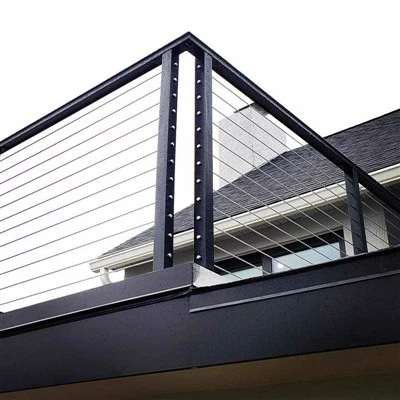
| Cable | Mostly open | Re-tension every 1–2 yrs | Modern look, water views, where climb-proofing is not a concern |
| Glass | Fully open | Regular cleaning; gaskets every 15–20 yrs | Premium view properties, windbreaks |

Picket is the workhorse: middle of the price band, longest "do nothing" life, and the only one of the three that is inherently climb-resistant because the lines run vertical. If the view is the whole point, see our glass panel deck railing; if the brief is a thin modern line, our steel cable railing covers the spec.
Built by a railing manufacturer, not a reseller
We extrude and powder-coat the aluminum in our own plant, and the engineers who set the baluster spacing and sign the load notes are the same people standing at the line - not a trading desk reprinting a catalogue. That matters for an overseas specifier because the questions that stall a job ("will this pass IBC in my state?", "what is the post spacing at 42″?", "can you PE-stamp it?") get answered from the shop floor, with drawings, not from a brochure. Every order leaves with a specification sheet you can forward to your architect or building official, referenced to the actual code section rather than a vague "compliant" claim.
Engineered and built to your drawing
A guard is never one length. We take your sketch - a deck run, a balcony edge, a switchback stair - and return a post, rail and baluster schedule with the structural notes attached: post spacing for the chosen height, baluster count and spacing per panel, anchorage detail for surface vs fascia mount, and the load path into the structure. Where the authority having jurisdiction requires it, we support PE stamping and supply the calculations. Finish, baluster profile, top-rail shape and color are yours to set; we have built spear-less square, round, twist and slimline balusters, wood-top-rail hybrids, and coastal-grade 316 packages - the drawing is the spec, not a menu we limit you to.
Where metal picket railings earn their keep
- Residential decks - the default guard; climb-proof for kids and pets, no annual work.
- Balconies and walkways - multifamily and commercial runs where 42″ and a 200 lb top rail are mandatory and the owner wants zero callbacks.
- Stairs - interior and exterior, with a graspable handrail profile built into the top rail.
- Porches and perimeters - traditional square pickets or ornamental steel for a period facade.
- Coastal and pool-deck edges - aluminum + 316 hardware shrugs off salt; pair with our fence team if a pool barrier (not a guard) is also needed.

Frequently asked questions
Q: What is the difference between a metal railing with pickets and a picket fence?
A: A picket railing is a fall-protection guard for surfaces over 30″ above grade - decks, balconies, stairs - built to 36″/42″ heights and 200 lb / 50 plf guard loads. A picket fence is a ground-level boundary for property lines, pets and pools, judged on wind load and rackability, not fall protection. Different product, different rules; we cover the fence on our aluminum fence pickets page.
Q: How far apart should balusters be spaced?
A: The clear gap between balusters must be under 4″ so a 4″ sphere cannot pass (IRC R312 / IBC 1015). We typically set balusters about 3.5–3.66″ on center for slim sections, which leaves a safe, even gap and bakes the spacing into the factory panel rather than leaving it to the installer.
Q: Is aluminum or steel better for baluster railings?
A: Aluminum is lighter, never rusts, and carries a 30+ year wash-only life - the default for export and coastal work. Steel (or wrought iron) is stronger per kilo and can be forged into ornamental profiles, but needs galvanize + powder coat and a repaint cycle or it rusts. Pick steel for character, aluminum for low life-cost.
Q: Do metal baluster railings need a graspable handrail on stairs?
A: If the guard also serves as the handrail, yes - the top rail must be graspable (about 1.25″–2″ diameter or equivalent profile) and sit 34–38″ above the stair nosing, continuous with extensions. On a stair that already has a separate wall or stringer handrail, the guard itself just meets the guard rules.
Q: Can picket spacing be made tighter for a puppy or a view?
A: Yes. We build custom baluster spacing and density to your drawing - tighter clusters for small-pet situations, or slimline balusters spaced to read lighter where the view matters. The only hard limit is the <4″ maximum gap for guards; going tighter is purely a design call.
Q: Will a metal baluster guard pass inspection in my state?
A: We build to IRC (36″ residential) and IBC (42″ commercial) guard loads and the 4″ sphere rule, and we flag the districts that amend them (California and NYC require 42″ even on houses; some cities differ on opening size). Send your jurisdiction and we return the schedule with the relevant code references so your inspector gets what they expect.
Q: Is a picket guard cheaper than cable or glass?
A: Installed aluminum picket typically runs ~$50–$100 per linear foot - less than cable at the high end and well under glass, and its 30-year near-zero upkeep makes the lifetime cost the lowest of the three. Glass and cable cost more for the view; picket costs more for peace of mind.
Q: Can you build to my drawing and stamp the calculations?
A: Yes. Send the run, stair or balcony sketch and we return a post/rail/baluster schedule with load notes; where the AHJ requires it we support PE stamping and supply the calculations. Finish, profile, top-rail shape and RAL color are set by you, not limited by us.
Hot Tags: metal railing with pickets, China metal railing with pickets manufacturers, suppliers, factory, aluminum handrail system, Luxury Outdoor Deck Railing, residential balcony railing, residential handrail, Residential Outdoor Deck Railing, surface treatment of railing