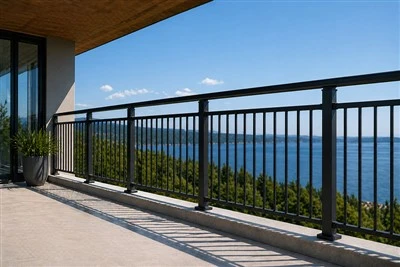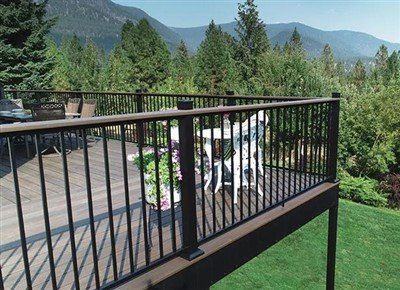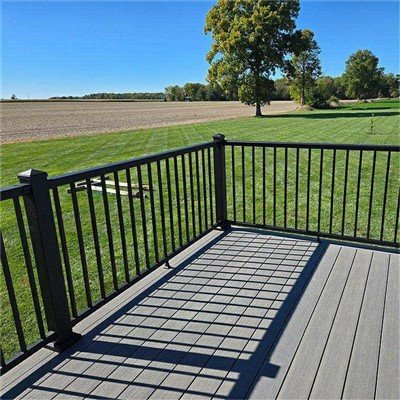
ZP Aluminum Co., Ltd. is one of the most reliable manufacturers and suppliers of aluminum fence pickets in China. If you're going to buy bulk high quality aluminum fence pickets made in China, welcome to get quotation from our factory. We also accept customized orders.
Aluminum Fence Pickets:
Powder-Coated Picket Panels, Engineered for Your Boundary
A picket fence does a different job from a deck or balcony guard. It draws the property line, keeps a child or a dog in (and the wrong wildlife out), and meets the pool barrier code - without ever rusting,rotting, or asking for a paintbrush. We extrude the aluminum, powder-coat it in-house, and ship fully assembled panels to your spacing, height and style. You are not buying a catalogue length of fence; you are buying a boundary system built to your site.

Pick the right page for your guard height
This page is a ground-level boundary / pool / pet fence - a property-line barrier, not a fall-protection guard. If you actually need a guard above a floor or deck opening, those are separate systems:
Deck Railing System - fall protection on an elevated deck or balcony (36″/42″ guards).
Glass Patio Railing - a low glass guard for a terrace or pool surround where you want the view, not a privacy boundary.
External Glass Balustrade - framed or frameless glass guard to building-code height.
What an aluminum picket fence actually is
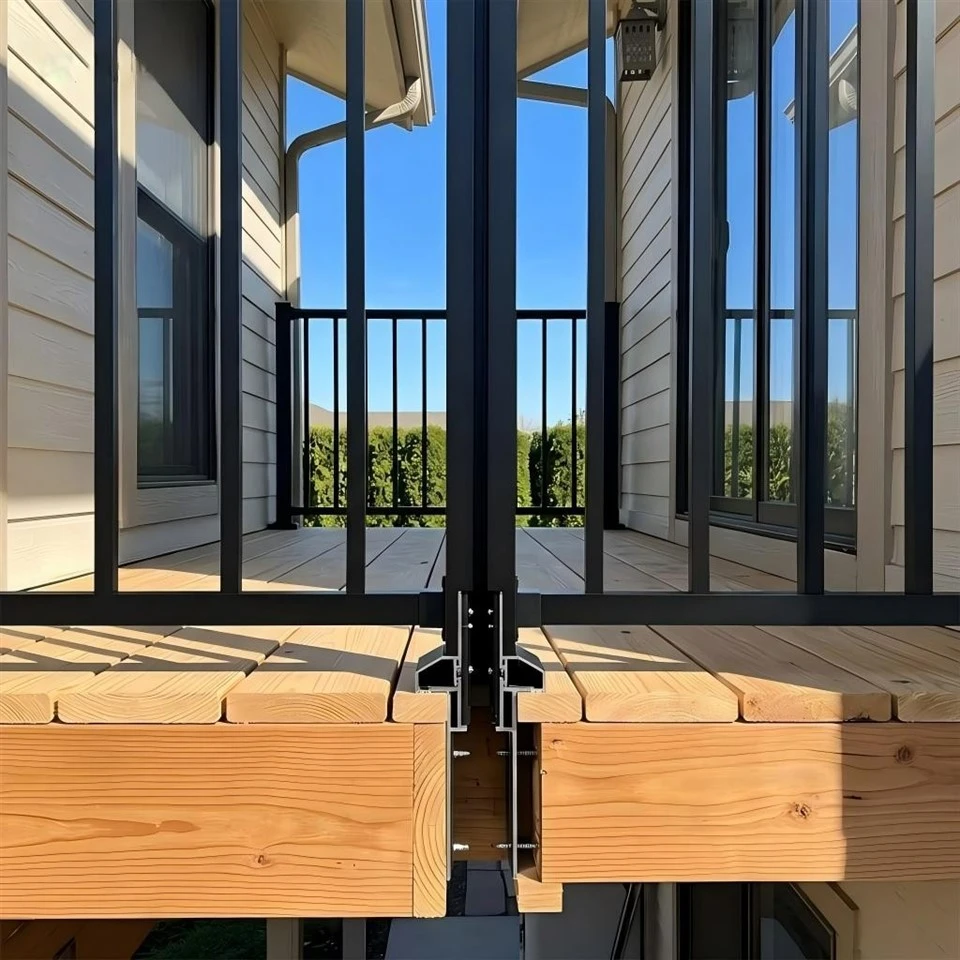
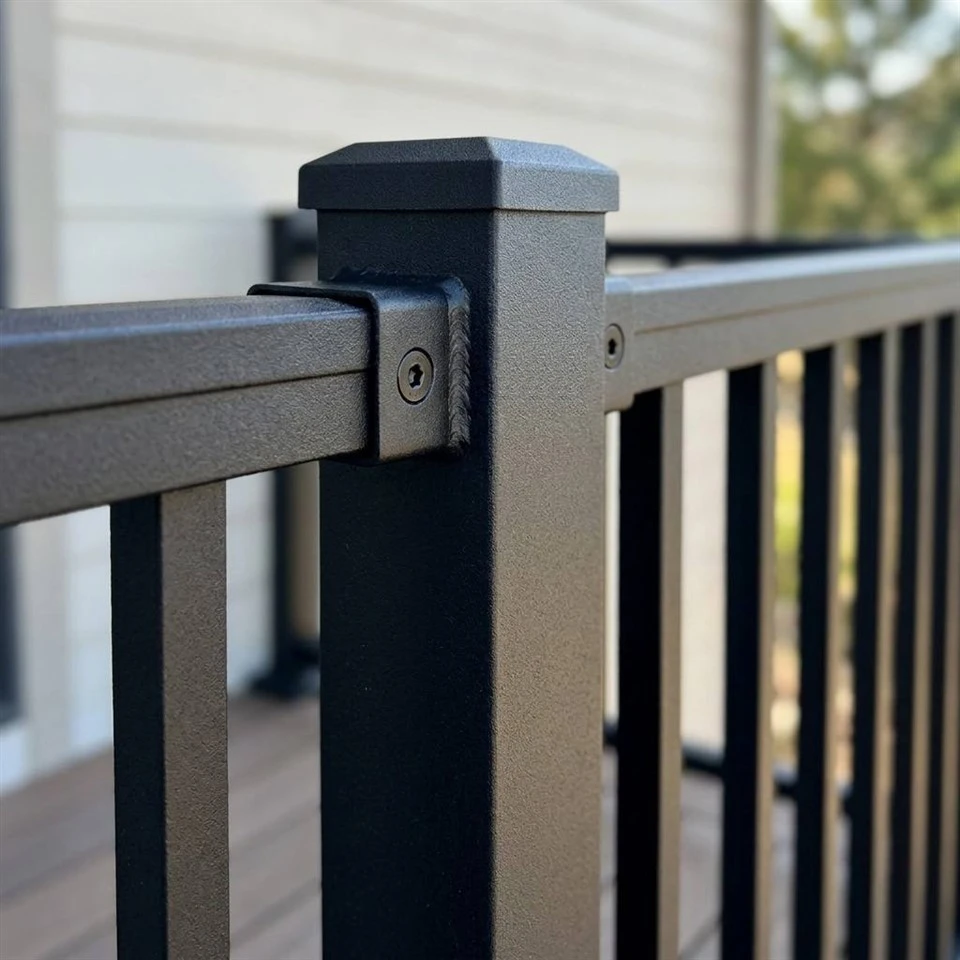
Strip away the marketing and a picket fence is three parts that have to work as one: vertical pickets set to a spacing that meets the job, horizontal rails that hold them, and posts that carry the whole panel to the ground. We build it as a factory-assembled panel - pickets punched into the rails, rails into the post system - so what arrives on site is a rigid section you stand up between set posts, not a box of loose sticks.
The reason specifiers keep landing on aluminum over wood, vinyl or steel is the alloy itself. Extruded 6063-T5 or 6005-T5 aluminum forms a closed oxide skin the moment it is exposed to air, so it does not rust, does not need staining, and does not rot at ground contact. A fence we shipped in the early 2000s is still standing on sites today with its finish intact. That is the 30–50 year service life you are buying, not a sales claim.


Picket style: the look your property is asking for
The picket is the only part anyone sees up close, so the profile and top cut set the whole tone. We run the common ornamental vocabularies and will mix them within a single order:
- Spear top - pointed finial, the classic estate / wrought-iron imitation. Reads as "defined boundary" and slightly discourages climbing.
- Flat top - clean squared picket, the modern and HOA-friendly choice for contemporary homes and commercial perimeters.
- Alternating / staggered spear - every other picket steps up, a decorative rhythm used on gateway and corner runs.
- Scroll or ring accents - cast or formed ornaments mid-picket for heritage and hospitality projects.
- Puppy picket - a second row of closely set pickets in the bottom band (typically the first 16″), described in its own section below.
Pickets are 5/8″ square on residential grades and step up to 3/4″ and 1″ square on commercial and industrial grades, with wall thickness rising from .050″ to .062″ as the security level climbs. Tops are finished with flat, ball or decorative caps on every post.
Choosing the height
Height is driven by what the fence is protecting, not by taste. The table below is the short version we give specifiers:
| Height | Typical use | Code note |
| 36" | Garden border, decorative front-yard definition | Below most pool-barrier minimums |
| 42–48″ | Pet containment, general boundary, pool code compliant in many jurisdictions | Often the minimum for a pool barrier (check local IRC/IBC adoption) |
| 54–60″ | Security perimeter, HOA boundaries, pool enclosures with a self-latching gate | Standard for pool surrounds where sight lines matter |
| 72″+ | Commercial / industrial, equipment yard, privacy with added slats | Requires 4th rail and heavier post wall |
We cut panels to actual height, not nominal, and will build custom heights between the standard steps if your drawing calls for it.
Picket spacing: where safety and cost meet
This is the one number that decides whether a fence actually does its job. The governing idea is the same sphere rule you see on railings - a 4″ sphere (roughly a small child's head) must not pass - but on a boundary fence the failure mode is different: a dog squeezing out, or a child's head catching between pickets.
- Standard spacing, 3-3/4″ (3.816″) - the default for front yards and pools. Open sight line, economical, meets the 4″ rule with margin.
- Puppy / pet spacing, 1-5/8″ (1.596″) - pickets doubled in the bottom band so a toy breed or a persistent digger stays in and a raccoon stays out. We keep the upper section at standard spacing so the fence does not read as a cage.
- Custom 2–3″ - a middle ground for small-dog clients who do not want the full puppy look.


Aluminum vs wood, vinyl and steel - read it over the fence life
First cost is the wrong lens. Wood is cheaper at the gate but bleeds money in stain, seal and board replacement; vinyl is middle-priced but goes brittle in cold and yellows with UV; steel is strong but rusts at every cut and weld. Aluminum sits at a higher entry price and then asks almost nothing of you for decades.
| Material | Installed $/lf | Yearly upkeep | Service life | Coating | Notes |
| Aluminum | $25–$60 | Rinse + occasional coating touch-up | 30–50 yrs | AAMA 2604/2605 powder | No rust, racks to slopes, ~100% recyclable |
| Vinyl | $20–$55 | Wash | 20–30 yrs | UV-stabilized PVC | Brittle below ~20°F, can crack on impact |
| Wood | $15–$45 | Stain/seal annually | 10–20 yrs | Paint / stain | Rot at ground, insect damage, high lifetime cost |
| Steel / iron | $50–$120 | Repaint every 2–3 yrs | 25–50 yrs | Galvanize + powder | Strongest, but corrosion at welds is inevitable |
For a facility manager or an HOA, the math is the selling point: fewer work orders, no repaint cycle, no panel replacement program. That is why aluminum shows up on healthcare campuses, car-wash sites and coastal boardwalks where a plastic or wood fence would quietly fail.
Wind load and slope - the two things that break a cheap fence
A boundary fence is a vertical sail. The question is not "will the wind come," but "what does the panel do when it does." We engineer panels to a 90–120 mph wind rating with proper post setting, using a heavier rail wall and a fourth rail on tall runs. Posts are specified by wall thickness (.060″ residential up to .125″ commercial/industrial) and set to local frost depth - typically 36″ in freeze zones - in concrete footings, with gate and corner posts run deeper.
Slope handling is a separate discipline. Rackable panels follow the ground without gaps; stair-stepped panels do not. We default to racked sections on any run with more than a few inches of fall, and we note the rack limit on the panel schedule so the installer is never guessing.
Posts, gates and the pool code
Posts come as line, corner, end and gate types, 2″ square on residential grades up to 3″ square on industrial, each with its cap style. Gate posts are the heavy-wall versions because a swinging leaf loads the hinge post every cycle.
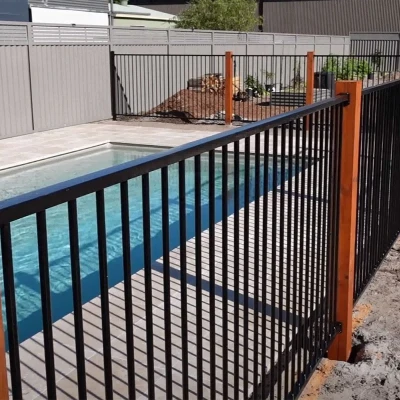
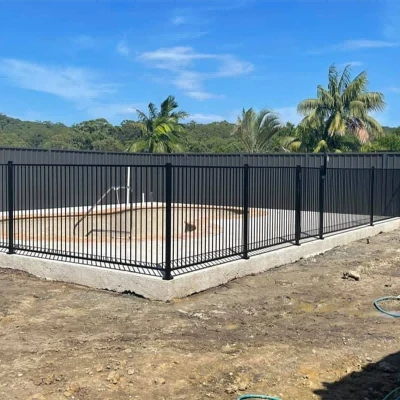
For pool enclosures the gate is the code-critical part. We build walk and double-drive gates with self-closing, self-latching hinges and a latch placed above the reach of a small child, exactly as IRC/IBC pool-barrier rules require. A fence around a pool has to let you see the water from the house - open pickets do that, solid panels do not - which is why aluminum picket fencing is the default pool barrier rather than vinyl.
Built in our plant, drawn to your site
We are a fencing manufacturer, not a trading desk reselling imported lengths. The aluminum is extruded, the TGIC-polyester powder coat is applied in a multi-stage line we run, and panels are assembled and racked in our own shop before they ship. That vertical control is what lets us take a property sketch and return a complete schedule - panel count, post type per location, gate size, and the rack treatment for each sloped run - instead of a price per foot and a shrug.
Every order runs through our engineering desk before it is cut: wind load against the height and local exposure, post set depth against frost line, picket spacing against the 4″ rule and any puppy requirement, and gate hardware against the pool code where it applies. You get shop drawings and a bill of materials you can hand to your installer or forward to the AHJ - and PE stamp support where the jurisdiction asks for it. Color is any RAL you name; matte black remains the most-requested because it hides minor soil and reads as deliberate on both traditional and modern elevations.
Typical specification (residential grade)
- Alloy: 6063-T5 / 6005-T5 extruded aluminum, min. 35,000 psi
- Pickets: 5/8″ sq × .050″ wall (residential); 3/4″ sq × .055″ (commercial); 1″ sq × .062″ (industrial)
- Rails: 1-1/8″ × 1″ (residential), 2–3 rails by height; 4th rail added at 72″+
- Posts: 2″ sq × .060″ wall line / .125″ gate (residential); up to 3″ sq industrial
- Spacing: 3-3/4″ standard; 1-5/8″ puppy band; custom 2–3″
- Post centers: 72.5″ O.C. (8′ sections available)
- Finish: TGIC polyester powder coat, AAMA 2604 / 2605, RAL custom
- Rackability: up to ~24–26″ over 8′ standard; Max-Rack for steeper
- Wind: 90–120 mph with specified set depth
- Standards: ASTM F1400 (aluminum fencing); IRC R312 / IBC 2407 pool-barrier references
Frequently asked questions
Q: Will an aluminum picket fence actually contain my dog?
A: Yes for most breeds at standard 3-3/4″ spacing. For toy or persistent dogs, specify the puppy-picket band (1-5/8″) in the bottom 16″ - that closes the gap small breeds and wildlife use. Also hold bottom clearance to ~1–2″ and add a ground barrier if digging is the risk, not climbing.
Q: Can aluminum fencing follow a sloped yard?
A: It can, and it should be racked rather than stair-stepped. Racked panels let each picket slide to the grade so spacing and ground clearance stay constant; stair-stepping leaves triangular gaps. We size the rack treatment from your grade and note the limit on the panel schedule.
Q: Is aluminum strong enough, or will a picket bend?
A: Residential aluminum runs about 25,000–35,000 psi yield - enough to contain pets and children and resist normal impact. A hard hit from a mower or vehicle can dent a thin picket; specify heavy-wall (.125″) commercial grade where equipment or larger dogs are a concern.
Q: How deep do the posts need to go?
A: To local frost depth - commonly 36″ in freeze zones - set in concrete footings, with gate and corner posts deeper. Posts set at 24″ will heave as the ground freezes and thaws, which loosens panels and creates escape gaps.
Q: Does it meet pool code?
A: Open picket aluminum at 42–60″ with a self-closing, self-latching gate meets the typical IRC/IBC pool-barrier rules, and the open pattern lets you see the water from the house. We build the gate hardware to that spec and can supply PE stamp support where the AHJ requires it.
Q: Aluminum vs wood - is the higher price worth it?
A: Over the fence life, yes. Wood is cheaper upfront but needs annual stain/seal and board replacement; aluminum needs a rinse and the occasional coating touch-up and runs 30–50 years without rust or rot. The lifetime cost usually favors aluminum, which is why HOAs and facilities specify it.
Q: What colors and finishes are available?
A: Standard black, bronze, white, green and beige, plus any custom RAL through our powder line. Matte black is the most-requested for both traditional and modern properties. Finish meets AAMA 2604 (high performance) or 2605 (superior) depending on the coastal/UV exposure.
Q: Can you build to my drawing and dimensions?
A: That is the default, not an option. Send a property sketch with heights, gate locations and slope, and we return a panel / post / gate schedule, shop drawings and BOM. Custom heights, puppy spacing, mixed styles and rack treatment are all handled at the plant before shipping.
Hot Tags: aluminum fence pickets, China aluminum fence pickets manufacturers, suppliers, factory, aluminum guardrail system, Aluminum Outdoor Deck Railing, luxury aluminum deck railings, outdoor railing systems, Residential Outdoor Deck Railing, Weatherproof Deck Railing