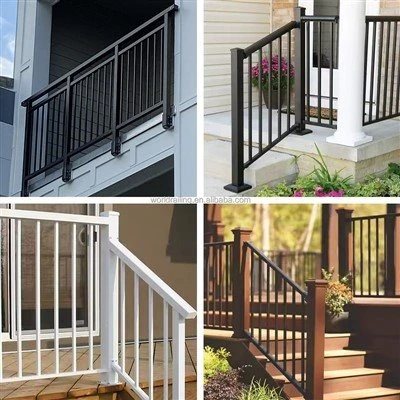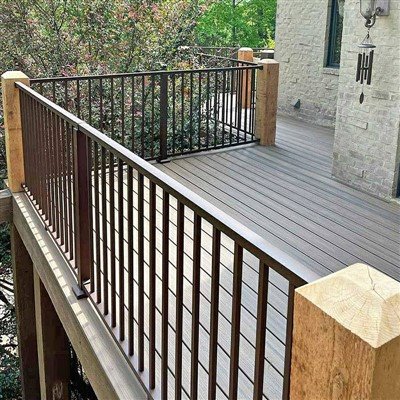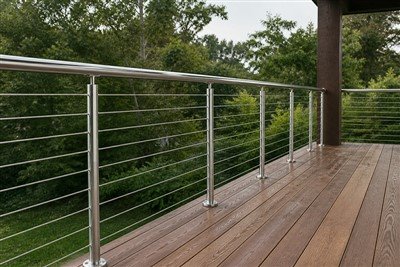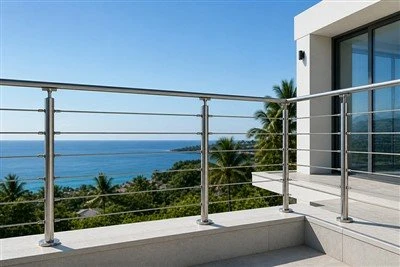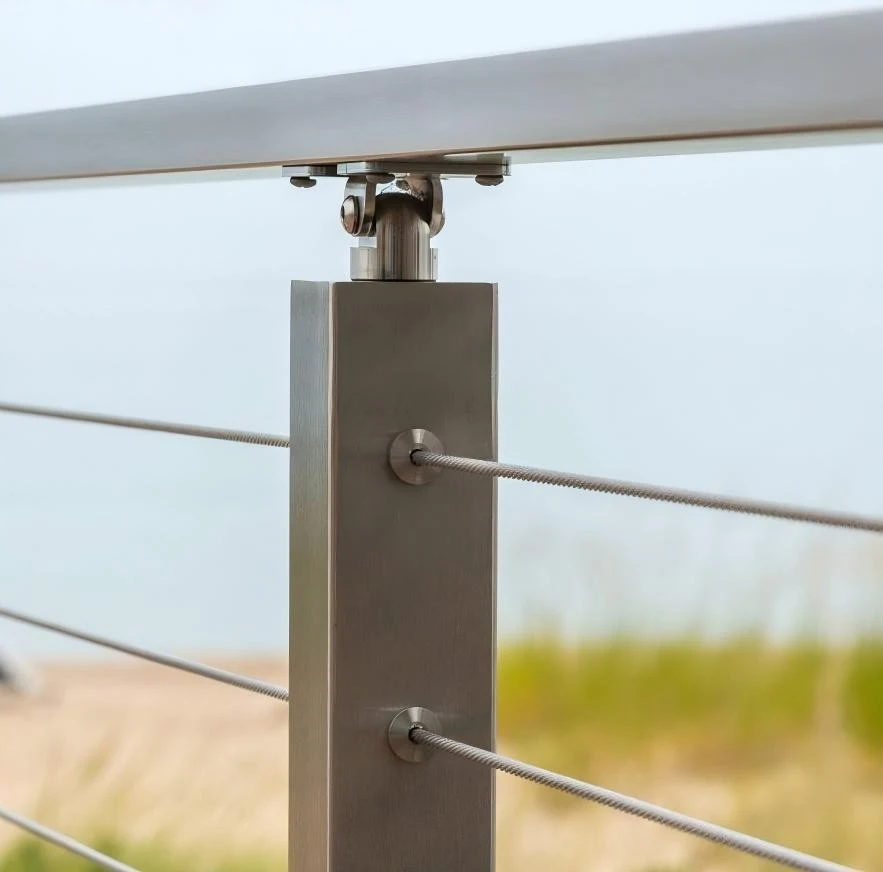


ZP Aluminum Co., Ltd. is one of the most reliable manufacturers and suppliers of stainless steel handrails for outdoor steps in China. If you're going to buy bulk high quality stainless steel handrails for outdoor steps made in China, welcome to get quotation from our factory. We also accept customized orders.
Stainless Steel Handrails for Outdoor Steps
A code-compliant graspable handrail built to the pitch of your steps - wall-mounted or free-standing on posts, in 316 or 304 stainless, with code-compliant returns and load-tested fixings for garden, deck, fire-escape and entrance stairs.

Most "handrail" listings sell a length of tube. For outdoor steps the real job is different: the rail has to match your stair angle, stay graspable in the wet, and prove its fixings hold when someone leans on it at the top of a flight. A stainless steel handrail for outdoor steps is the safety rail you hold on a garden stair, a deck stair, a fire escape or a public entrance stair - wall-mounted or post-mounted, built to the pitch of the steps and the chloride load of the site. This page is about specifying that rail: the 316-vs-304 grade decision, wall vs post mounting, how to size it to a real stair, and the graspable-profile and continuity rules the codes actually enforce.
Why Stainless - And Which Grade
Outdoor steps expose a handrail to rain, UV, de-icing salt and (on many sites) pool chlorine or sea spray. Carbon steel rusts and painted railings chip at the bracket welds; stainless is the default for a rail that has to look right and stay safe for years without repainting. The choice inside "stainless" is the grade:
| Grade | Composition | Best for | Relative cost |
| 304 (18-8) | 18% Cr, 8% Ni, no molybdenum | Inland, dry, low-chloride sites | Baseline |
| 316 (18-10-2/3) | 16-18% Cr, 10-14% Ni, 2-3% Mo | Within ~10 mi of coast, poolside, de-icing salt, humid tropics | +15-30% |
| 316L | 316 with low carbon | Heavy welding (posts, returns) where you want to avoid weld decay | ~316 |
The molybdenum in 316 is what resists pitting in chloride environments. For an outdoor step rail that sees sea air, pool splash or winter salt, 316 is the grade we specify - 304 will eventually tea-stain and pit at the bracket welds. For a covered inland stair, 304 is the value choice. We fabricate both and will tell you straight which one your site needs.
Wall-Mounted vs Post-Mounted
A step handrail is fixed one of two ways, and the choice drives the bracket and post schedule:
- Wall-mounted. The rail cantilevers off brackets bolted to the wall or stringer beside the steps. No posts on the treads, so it reads clean and never interferes with foot traffic. Needs a solid wall or stringer to anchor into (concrete, block, or a timber/steel stringer). Brackets typically every 36-48 in (900-1200 mm); closer spacing cuts deflection.
- Post-mounted. Upright posts bolt to the step treads (base plate) or the side (core-drilled), and the rail runs between them. Free-standing, no wall required - the usual pick for open deck stairs, garden steps and freestanding entrances. Posts 4-6 ft (1.2-1.8 m) apart; closer on long runs keeps the rail stiff under the 200 lb (0.89 kN) point load.
We build both, and a third hybrid: a wall return at the top with posts down the open side. Tell us what the steps are made of and whether there is a wall, and we return the fixing schedule.
Sizing a Handrail to a Real Stair
Off-the-shelf rails rarely fit a real stair, because pitch varies. We size from three numbers you can measure with a tape:
- Total rise - finished-floor to finished-floor height of the flight.
- Total run - horizontal span of the flight.
- Step count - to confirm the pitch is consistent.
From those:
- Pitch angle θ = atan(rise ÷ run). Most steps sit between 30° and 45°.
- Slope length = √(rise² + run²) - the rail length along the pitch, before extensions.
- End extensions. Codes want the rail to extend at least 12 in (300 mm) horizontally beyond the top and bottom nosing, or to return into the wall or a post. So add those extensions to the slope length.
- Height. 34-38 in (865-965 mm) measured vertically above the stair nosing line - the same plane the whole flight.
Because every stair is a different angle, we cut and bend the rail (and the posts or brackets) to your measured pitch, not a catalogue 35°. Send the rise, run and a photo and we return the exact length and cut list.
Graspable Profile & Continuity - What the Codes Actually Say
A step handrail has to be graspable and continuous, and that is where cheap tubes fail inspection:
- Profile. Circular rails: 1.25-2 in (31.8-50.8 mm) outside diameter. Non-circular: perimeter 4-6.25 in (100-160 mm) with a maximum cross-section of 2.25 in (57 mm). A fat 2.5 in (63 mm) tube looks sturdy but fails the graspable rule.
- Continuity. The rail must run the full length of the flight without a break (switchback stairs may interrupt only at the landing).
- Returns. Each end must return to the wall, floor or a post, or turn downward - so a sleeve or coat cannot catch on the open end. This is the detail most DIY rails miss.
- Load. IBC 1014 / IRC R311.7 call for 200 lb (0.89 kN) concentrated at any point along the top, or 50 lb/ft (0.73 kN/m) uniform. Our post and bracket schedules are set so the rail meets that with deflection within L/60.
We deliver shop drawings that show the profile, the return detail and the load path, so your inspector sees compliance on paper before the rail is installed.
Engineered to Your Steps, in Our Plant
A step handrail is made from your stair, not a shelf. Send the rise and run (or a template of the flight), the substrate the fixings land in, the rail height and finish, and whether you want wall or post mounting; our engineers return the cut list, the bracket/post schedule, the return detail and load-and-deflection notes for code - with PE-stamp support where the jurisdiction requires it. We cut, bend and TIG-weld the stainless in our own shop to the profile and pitch your steps call for, and a sample rail section is available so you can verify the finish and grasp before a full run. Mill pricing, mixed wall-and-post runs, and container or small-batch freight: send your stair and we quote within two business days.


Surface Finish for Outdoor Steps
| Finish | Look | Outdoor notes |
| #4 brushed (satin) | Soft directional grain | Most common; hides rain spotting and light scratches; easy to maintain |
| Bead-blasted | Uniform matte | Modern, low-glare, less show of water marks |
| #8 mirror | Reflective polish | Decorative; shows water spots and fingerprints, needs more care |
For steps that get rained on, #4 brushed or bead-blasted are the practical choices; #8 mirror is for sheltered, design-led entrances.
Wet, Coastal & Poolside Sites
The harshest step-handrail environments are the ones we see most:
- Coastal (within ~10 mi / 16 km of the sea) - salt-laden air; 316 mandatory, with drainage so water does not pool at the brackets.
- Poolside - chlorine is a chloride; 316 and a finish that wipes clean.
- Winter climates - de-icing salt is corrosive; 316 plus bracket welds done in 316L to avoid weld decay.
- Humid tropics - constant moisture; 316 and good ventilation at the fixings.
On any of these we default to 316 and specify the weld grade and drainage so the rail outlasts the steps it guards.
Typical Specification
| Parameter | Standard |
| Material | Stainless 304 or 316 (316L welds on heavy fabrication) |
| Mount | Wall-mounted (brackets) or post-mounted (base plate / core drill) |
| Profile | Circular 1.25-2 in OD, or non-circular ≤6.25 in perimeter |
| Height | 34-38 in (865-965 mm) above nosing |
| Extensions | ≥12 in (300 mm) top & bottom, or returns |
| Post / bracket spacing | Posts 4-6 ft · brackets 36-48 in |
| Load | 200 lb point · 50 lb/ft uniform (IBC 1014 / IRC R311.7) |
| Finish | #4 brushed · bead-blasted · #8 mirror |
| Code | IBC 1014 · IRC R311.7 · ADA 505 · BS 6180 · AS 1428 |
| Engineering | CAD cut list · load-deflection notes · PE stamp on request |
Frequently Asked Questions
Q: 316 or 304 for my outdoor steps?
A: If the steps are within roughly 10 miles of the coast, near a pool, or get winter de-icing salt, specify 316 - the molybdenum resists the chloride pitting that eventually eats 304 at the welds. For a covered, inland, dry stair, 304 is the value grade. We will tell you which your site needs.
Q: Can a handrail be wall-mounted if my steps have no wall?
A: No - wall-mounted needs a solid wall or stringer to anchor the brackets. If the steps are open, go post-mounted (posts bolt to the treads or side). We also build hybrids: a wall return at the top with posts down the open run.
Q: How do I know how long the rail should be?
A: Measure the total rise and total run of the flight; the slope length is √(rise² + run²), then add at least 12 in at the top and bottom (or returns). Send us those two numbers and we return the exact cut length for your pitch.
Q: What makes a handrail "graspable"?
A: Circular rail: 1.25-2 in outside diameter. Non-circular: perimeter 4-6.25 in with a max cross-section of 2.25 in. A too-fat tube fails the graspable rule even though it looks stronger - we build to the code profile.
Q: Do the ends need to return?
A: Yes, under IBC/IRC the ends must return to the wall, floor or a post, or turn downward, so nothing catches on the open end. It is the detail most off-the-shelf rails skip; ours include it by default.
Q: Do you provide engineering for the handrail?
A: Yes - we supply the cut list, bracket/post schedule, return detail and load-and-deflection notes, with PE-stamp support where your jurisdiction requires sealed calculations, to IBC, IRC, BS 6180 or AS 1428.
Q: What finish is best outdoors?
A: #4 brushed or bead-blasted - both shrug off rain spotting and light marks. #8 mirror looks great but shows water spots and needs more care, so reserve it for sheltered entrances.
Hot Tags: stainless steel handrails for outdoor steps, China stainless steel handrails for outdoor steps manufacturers, suppliers, factory, Aluminum Picket Railing, glass balustrade systems, Metal Deck Railing Pickets, outdoor aluminum picket railing, outdoor stainless railing, stainless steel and glass railing