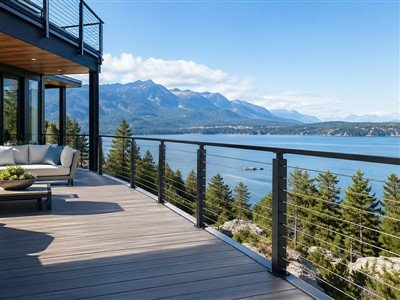
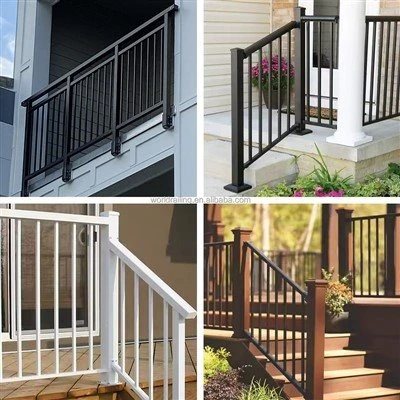
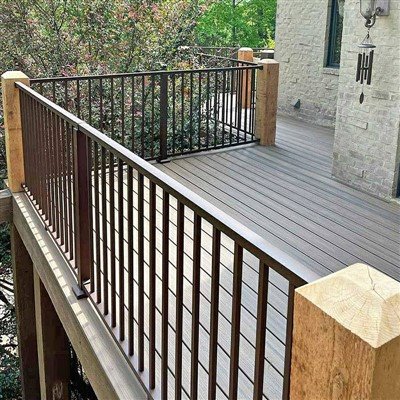
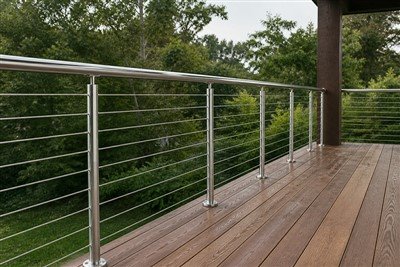
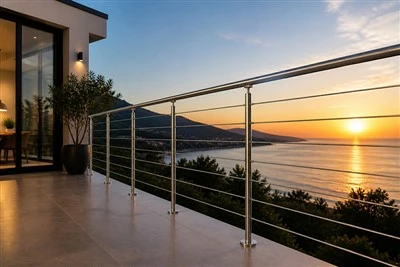
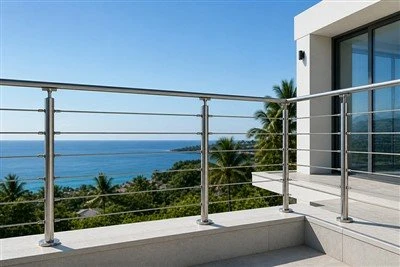
ZP Aluminum Co., Ltd. is one of the most reliable manufacturers and suppliers of stainless steel cable railing systems for decks in China. If you're going to buy bulk high quality stainless steel cable railing systems for decks made in China, welcome to get quotation from our factory. We also accept customized orders.
Stainless Steel Cable Railing Systems for Decks
Most "stainless cable railing" listings ship an aluminum frame with a stainless cable and call it stainless. A genuine stainless steel cable railing system for decks means every load path - posts, top and bottom rails, brackets, tensioners, even the through-bolts - is stainless, so the run ages as one metal instead of tea-staining at every aluminum-to-steel junction. This page is about specifying that complete stainless system for a deck, and deciding whether 316 or 304 is right for your site - salt air, pool chlorine, year-round humidity or dry inland. Cable construction (1×19, diameter) lives on our Steel Cable Railing page; how a cable system mounts to a deck and meets deck code is on Steel Cable Deck Railing.

Pick the right page for your question
Cable construction (1×19, diameter, break strength)? Go to Steel Cable Railing.
Mounting cable to a deck & deck code (blocking, 36″/42″)? See Steel Cable Deck Railing.
Horizontal or vertical run engineering (post moments, spacing)? See Horizontal or Vertical Cable Railing.
Aluminum vs steel for the frame (powder coat, AAMA)? See Metal Cable Railing.
Choosing a COMPLETE stainless system & 316 vs 304 for your deck environment? You are in the right place.
What "Stainless Steel Cable Railing System" Actually Means
A cable guard is only as corrosion-proof as its weakest metal. On a coastal or poolside deck, a system built from an aluminum frame, a 304 cable and plated steel tensioners will outlive its looks by a few seasons - the steel fittings rust first, then the aluminum frame pits where it meets the stainless cable (galvanic corrosion), and the run that looked marine-grade on day one reads "cheap" by year three. A true stainless steel cable railing system removes that weak link: posts and rails from 316 or 304 stainless tube and bar, stainless brackets and tensioners, and stainless through-bolts - one corrosion class end to end. We fabricate the posts, rails and tensioners in our own plant from stainless stock, so the grade you specify is the grade in the crate, not a mixed-metal compromise.
That is the difference between "stainless cable" and a "stainless system," and on a deck exposed to weather it is the difference between a guard that still looks engineered in ten years and one that needs replacing.
316 vs 304 - Picking the Grade for Your Deck Environment
Both are austenitic stainless and both take a clean, modern line. The decision is about the environment, not the look:
| Item | 304 stainless | 316 stainless |
| Alloy addition | 18% Cr, 8% Ni | 16% Cr, 10% Ni, 2–3% molybdenum |
| Chloride resistance | Moderate - pits near pools/chlorine | High - molybdenum resists chloride pitting |
| Coastal (salt air) | Within ~1–2 mi of coast, tea-stains | Baseline within ~10 mi of salt water |
| Poolside (chlorine) | Not recommended | Recommended |
| Price | Lower (baseline) | +15–30% over 304 |
| Best deck use | Dry, inland, low-humidity | Coastal, poolside, marina, rooftop, humid |
The molybdenum in 316 is what lets it shrug off chlorides - salt spray and pool chlorine are both chloride exposures, and they are the two things that destroy 304 on a deck. For any deck within roughly ten miles of the coast or anywhere around a chlorinated pool, we default the whole system to 316, cable and hardware included. Inland, low-humidity decks can run 304 and still look sharp for years; we will tell you honestly which grade your site needs rather than upsell by reflex.
Why Stainless Over Aluminum or Powder-Coat for a Deck
Aluminum frames with a superdurable AAMA 2605 powder coat are lighter and cheaper, and for many inland decks they are the right call. But stainless earns its premium in specific deck situations:
| Stainless (316/304) system | Aluminum + powder coat | |
| Weight | Heavier - needs stiffer deck backing | Light - easier retrofit |
| Corrosion in chlorides | Excellent (316) | Coating dependent; scratch = pit |
| Look | Real metal, brushed or mirror | Painted look, fades over decades |
| Joinery | Can be welded into monocoque posts | Mechanically joined |
| Cost | Higher | Lower |
| Best for | Coastal / pool / marine / architectural | Inland / budget / lightweight |


Stainless reads as a "real metal" guard - a brushed or mirror finish that catches light and never needs repainting. Where the deck sits in a corrosive environment or the architect wants an all-metal statement, stainless is the honest choice. Where weight, cost or a painted color match dominates, the aluminum route (see Metal Cable Railing) may fit better. We lay out both and let the site decide.
Finish and Look - Brushed, Mirror or Bead-Blasted
A stainless deck system is as much an aesthetic decision as a structural one:
- #4 brushed (satin). The default for decks - a directional grain that hides water spotting and fingerprints, reads modern and stays low-glare in sun. Most residential and commercial decks spec this.
- #8 mirror (polished). A showpiece finish for architectural decks and luxury poolside; reflects the view but shows water marks and needs more upkeep.
- Bead-blasted / satin-matte. A soft, non-directional finish between the two - popular on contemporary rooftop decks.
Unlike powder coat, none of these finishes "wear through" to bare metal the way a scratched paint film does; a brushed surface can be field-refreshed with a scotch-brite pass. That is part of why stainless ages better on an exposed deck.
Mounting a Stainless System to a Deck
A stainless post lands on a deck the same two ways any cable post does - surface mount (base on the deck boards, bolts down into blocking) or fascia mount (bracket on the rim joist, off the walking plane). The stainless difference: because the posts are heavier than aluminum, the backing matters more, not less. Under every surface post we call for a double 2×6 blocking tied to the joists on all four sides; fascia posts need a doubled 2×8 rim or a reinforcing bracket. The full mount and code detail - 36″/42″ guard height, 4″ sphere, 200 lb load, stair handrail - is on our Steel Cable Deck Railing page; this page stays on the stainless system and the grade decision.
The Cable Inside the System
Within a stainless deck system the cable is 316 (or 304 to match) 1×19 construction - seven strands of nineteen wires, stiff and non-sagging so it holds a straight line between posts without stretch. Diameter runs 1/8″ to 3/16″; we size it to the post spacing and the tension load, not a catalogue default. Pre-tension is set center-out to ~200–300 lb per cable and re-checked after the deck's first seasonal move. Full cable construction and break-strength numbers are on Steel Cable Railing.
Deck Environments That Demand Stainless
Some decks should not be built in anything else:
Coastal homes and boardwalks - salt-laden air within miles of the water; 316 end to end.
Poolside decks - chlorinated water and constant splash; 316 cable and fittings.
Marina and dock edges - direct salt-water contact; 316 with periodic fresh rinse.
Rooftop terraces - exposed on all sides, often humid and wind-driven rain; 316.
Humid subtropical climates - where even "inland" decks see condensation cycles that pit 304.
For these, the stainless premium is insurance, not indulgence - it is what keeps the guard looking engineered instead of weathered.
Typical Stainless Steel Cable Deck Railing Specification
| Parameter | Standard |
| Posts/Rails | 316 or 304 stainless tube & bar (grade per environment) |
| Finish | #4 brushed (standard) · #8 mirror · bead-blasted |
| Cable | 316 (or 304) stainless 1×19, 1/8″–3/16″ |
| Tensioners / brackets / bolts | Stainless to match cable grade |
| Mount | Surface or fascia; wood / composite / aluminum deck |
| Backing | Double 2×6 blocking (surface) / double 2×8 rim (fascia) |
| Cable spacing | 3″ on-center (deflection-controlled) |
| Guard height | 36″ residential · 42″ IBC / commercial |
| Load | 200 lb concentrated · 50 lb/ft |
| Code | IRC R312 / IBC 1015 |
| Stairs | Separate graspable handrail 34–38″ |
Cable construction and break strength on Steel Cable Railing; deck mounting and code on Steel Cable Deck Railing; run orientation on Horizontal and Vertical Cable Railing.
Engineered to Your Deck, in Stainless
A stainless deck system is drawn from your deck, not pulled from a shelf. Send the deck plan, joist direction, post positions, heights and substrate; our engineers return a post-and-blocking schedule, the cable count and lengths, the tensioner list, and load-and-deflection notes for code - with PE-stamp support where the jurisdiction calls for it. We run the galvanic and deflection checks (stainless-to-aluminum deck interfaces included), issue CAD/shop drawings, and extrude, cut and drill the stainless in our own plant so the grade you approved is the grade that ships. Mill pricing, mixed stainless-and-wood looks, and container or small-batch freight: send your layout and we quote within two business days. Sample panels in 316 and 304 are available so you can compare the finish against your site before committing a run.
Frequently Asked Questions
Q: Is 316 really necessary, or is 304 enough for a deck?
A: It follows the environment. Within about ten miles of salt water, or anywhere around a chlorinated pool, 316 is the baseline - its molybdenum content resists the chloride pitting that destroys 304. Dry, inland, low-humidity decks can run 304 and look good for years. We tell you the grade your site needs rather than defaulting everyone to the expensive option.
Q: Can I mix a stainless cable with aluminum posts to save cost?
A: You can, and many decks do - but where the stainless cable meets the aluminum post you get galvanic corrosion unless the junction is isolated (a dielectric sleeve or a non-conductive grommet). If you go that route we isolate every contact point and still spec 316 for the cable and hardware. A full stainless system avoids the issue entirely, which is why we recommend it for coastal and poolside decks.
Q: Will stainless steel cable railing rust on a deck?
A: Properly graded stainless does not "rust" in the normal sense - 316 shrugs off salt and chlorine that would pit 304. What you sometimes see as "rust" on a deck is actually tea-staining (surface discoloration) from chlorides or from mixed metals, or iron contamination from steel tools during install. We ship 316 for corrosive sites, isolate dissimilar contacts, and recommend a fresh-water rinse for marina decks - so the run stays metallic, not orange.
Q: How much more does a full stainless system cost vs aluminum?
A: A complete 316 stainless deck system typically runs 25–60% above a comparable aluminum-and-powder-coat system, driven by material cost and the heavier backing it needs. 304 closes some of that gap. For coastal, poolside and architectural decks the premium buys decades of no repaint and no pitting; for a dry inland deck the aluminum route is often the better value. We quote both so you can weigh it against your site.
Q: Brushed or mirror finish for an outdoor deck?
A: Brushed (#4 satin) for almost every deck - it hides water spots and glare and field-refreshes with a scotch-brite pass. Mirror (#8) is a showpiece for luxury poolside or architectural decks but shows water marks and needs more care. Bead-blasted sits between them. Finish choice is aesthetic; corrosion resistance comes from the grade, not the polish.
Q: Can a stainless cable system go on a wood or composite deck?
A: Yes. Surface mount bolts down through the decking into added blocking; fascia mount hangs off the rim joist without piercing the walking surface (common on composite). Because stainless posts are heavier than aluminum, the blocking and rim joist backing matter more - we mark exact backing locations on the schedule we return. Mount and code detail is on our Steel Cable Deck Railing page.
Q: Does stainless need maintenance on a deck?
A: Little. Periodic fresh-water rinse in coastal and marina settings, and a pass with a non-abrasive cleaner if tea-staining appears. Unlike powder coat there is no film to scratch through; a brushed finish can be refreshed in place. We include a care note with every shipment.
Q: Can the system be welded, or is it mechanically assembled?
A: Both. We fabricate monocoque stainless posts by TIG welding in the plant for a seamless look, then drill to your cable count; field assembly is brackets and tensioners, not welding. Welded corners read as one piece - a clean architectural line that mechanical joints can't quite match.
About ZP Railing
We are a stainless and aluminum railing manufacturer supplying B2B buyers, contractors and distributors worldwide. Every stainless deck system is fabricated in our own plant from 316 or 304 stock you specify - posts, rails, tensioners and bolts to one grade - drawn from your deck plan with load-and-deflection and galvanic calculations, CAD/shop drawings and PE-stamp support where required. We quote within two business days and ship sample panels so you can verify the finish before a full run. Mill pricing, mixed stainless-and-wood looks, and global freight: send your deck layout.
Hot Tags: stainless steel cable railing systems for decks, China stainless steel cable railing systems for decks manufacturers, suppliers, factory, commercial deck railing, modern glass balustrade, outdoor metal deck railing, stainless balcony railing, stainless steel glass railing, stainless steel railing system