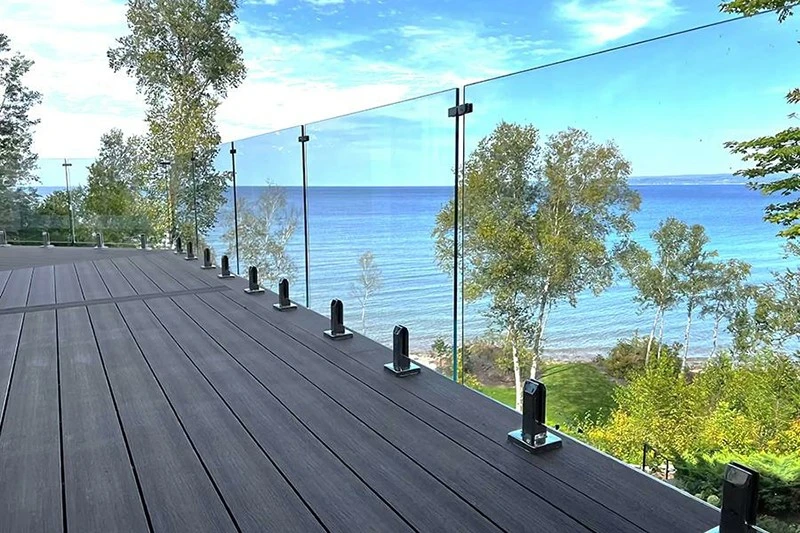
Wind Pressure and Span: When the width of a single glass pane exceeds 1.2 meters, it is recommended to increase the thickness by 1-2 mm for every additional 0.5 meters.
Certification Standards: Must comply with CCC certification (China) or EN 12150 (EU) standards and be marked with the "Safety Glass" label.
When purchasing, verify the 3C certification mark. For laminated glass, pay close attention to the quality of the interlayer bonding; request the manufacturer to provide a high-temperature and high-pressure test report. In coastal areas, choose corrosion-resistant frames, and use elastic sealant to cushion the glass-metal contact surface. In frigid northern regions, use insulated glass with caution, as frost formation on the interlayer can affect light transmission.
Glass type and thickness must comply with regulations: For glass railings that bear horizontal loads (such as leaning or pushing), indoor railings must use ≥12mm tempered glass or ≥16.76mm tempered laminated glass; when the height above the ground is ≥5m, tempered laminated glass must be used, and pure glass railings (without posts and handrails) are not allowed; for railings that do not bear horizontal loads (if there are independent posts and handrails), ≥5mm tempered glass or ≥6.38mm laminated glass is sufficient.
Height and spacing must strictly adhere to regulations: The net height of railings in all open areas (including balconies, stairs, and exterior corridors) must be ≥1.10m (unified requirement of the new national standard GB55031-2022); the net distance between vertical bars or glass partitions must be ≤0.11m to prevent children from getting their heads stuck; gaps >0.1m at the bottom should not be left to prevent falling objects or tripping.