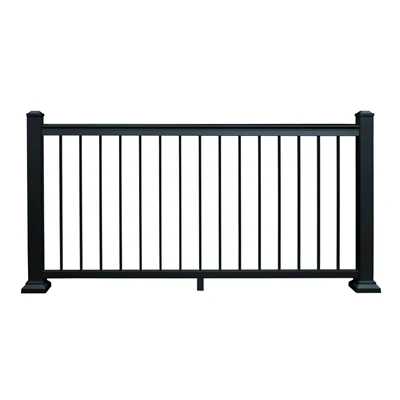
Both aluminum alloy and stainless steel railings have their unique advantages and applicable scenarios, making it impossible to simply say which is absolutely better. The specific choice depends on actual needs.
Performance Comparison
1.Corrosion Resistance: The core advantage of stainless steel railings lies in their excellent corrosion resistance. 304 stainless steel contains ≥18% chromium, maintaining stability in humid, acidic, and alkaline environments for extended periods, making it particularly suitable for coastal areas or chemically polluted regions. Aluminum alloy railings rely on a surface oxide film (such as anodizing) for protection. If this film is damaged (e.g., scratches, impacts), the exposed aluminum substrate easily reacts with oxygen in the air to form aluminum oxide. Although this forms a protective layer, pitting corrosion can still occur in high-salt spray environments.
2.Strength and Toughness: Stainless steel railings typically have a tensile strength above 520MPa and high hardness, making them suitable for applications requiring high impact resistance (such as traffic barriers). Aluminum alloy railings have a density only 1/3 that of stainless steel (approximately 2.7g/cm³), resulting in slightly lower strength (tensile strength approximately 200-300MPa), but better toughness and resistance to brittle fracture, making them suitable for applications requiring lightweight design (such as balconies and stair railings).
3.Appearance and processability: Stainless steel railings can achieve mirror, matte, and colored effects through processes such as wire drawing, polishing, and plating. However, complex shapes (such as arcs and hollows) require laser cutting or bending equipment, which is costly. Aluminum alloy railings have better processability. Complex cross-sections (such as floral and irregular tubes) can be directly produced through extrusion molding. Moreover, there are various surface treatment methods (such as wood grain transfer and fluorocarbon spraying), which can simulate the texture of stone and wood and meet personalized needs.
Applicability Comparison
1.Indoor Scenarios: For those seeking a high-end feel and with a sufficient budget, the mirror finish of stainless steel railings can enhance the space's ambiance; for lightweight designs or complex shapes, aluminum alloy railings offer greater processing advantages.
2.Outdoor Scenarios: Stainless steel railings (316 stainless steel) are preferred in coastal areas or highly polluted regions; aluminum alloy railings offer better value for money in arid inland areas or for projects requiring rapid installation.
3.Special Needs: Aluminum alloy railings are suitable for scenarios requiring frequent disassembly (such as temporary exhibition booths); stainless steel railings are necessary for scenarios requiring the resistance to heavy impacts (such as factory safety barriers).
Cost Comparison
1. Material Costs: Stainless steel railings have a higher raw material cost, especially 316 stainless steel (containing molybdenum, which has stronger corrosion resistance), which costs 1.5-2 times more than ordinary 304 stainless steel. The main cost of aluminum alloy railings is concentrated in surface treatment processes (such as anodizing and spraying). If ordinary powder coating is chosen, the cost can be controlled at 60%-70% of that of stainless steel.
2. Installation Costs: Stainless steel railings are heavier (approximately 8-12 kg/meter), requiring more robust fixing methods (such as expansion bolts + welding), resulting in higher labor costs. Aluminum alloy railings are lighter (approximately 3-5 kg/meter) and can be fixed with clips or screws, increasing installation efficiency by more than 30%, making them suitable for high-rise buildings or irregular structures.
3. Maintenance Costs: If the surface of stainless steel railings is scratched, it needs to be repaired by polishing or repainting, which is costly. The oxide film on aluminum alloy railings has self-healing properties; minor scratches can be repaired by oxidation to form a new protective layer, resulting in lower maintenance costs.